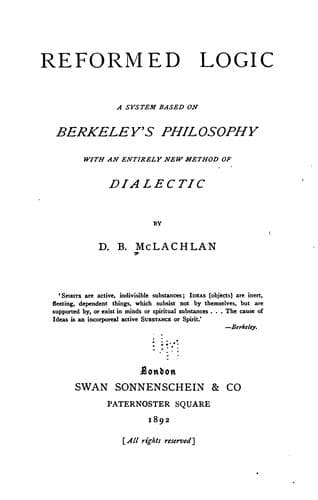
Reformed Logic: A System Based on Berkeley's Philosophy with an Entirely New Method of Dialectic — John Shaqi
Reformed Logic: A System Based on Berkeley's Philosophy with an Entirely New Method of DialecticMcLachlan, D. B.
Philosophy
Reformed Logic: A System Based on Berkeley's Philosophy with an Entirely New Method of Dialectic
McLachlan, D. B.
Logic
In metaphysic we are not obliged to recognise this convention. If an
object a mile off appears to be an inch high, it is an inch high
as really as if it were in a photograph or picture and materially
represented of that height. The mystery of the change of size in
objects is not explained or reasoned away by any device for overcoming
some of its practical inconveniences. It depends on the degree of
energy with which minds affect each other.
A group has properties which an object has not; or, if this be not
strictly the case, we may say that the properties we look for in a
group are not those we distinguish in a single object. The special
properties of a group are _positions_. It is unnecessary to say
'relative' positions, for position cannot be otherwise than relative.
Position cannot be defined by reference to anything more simple. What
is meant is intuitively known to everybody. But let us take a concrete
example--a man with a horse and cart standing on a bridge. Each object
in this group has a position towards the other objects. The bridge is
_over_ the river and _under_ the cart; the cart is _upon_ the bridge
and _behind_ the horse; the man is _in_ the cart; the horse is
_before_ and _outside_ of the cart, it is _near_ one end of the
bridge, _far_ from the other, and _between_ the two extremities. These
are the principal positions in a natural group or association,
by which is meant the objects we can see (or are supposed to see)
simultaneously, and whose mutual positions we are considering.
The use of observing positions is the same as that which moves us to
all rational study, namely, its value in prediction. We can reason
from one object to another in a group just as we reason from one
property to another in an object.
Suppose our perception of a landscape is interrupted for a moment,
and when we next endeavour to perceive it we find we only perceive a
portion of it, the rest being 'hidden' by an intervening object. As
far as we are concerned the hidden part has been annihilated. We only
remember what was there. But this recollection is also a preconception
of what we may be able to cause to appear again, either by removing
the obstructing object, by waiting till it has been removed, or by
walking round and standing between it and the landscape.
If this be too close to mere recollection, we have pure reasoning
when from the general appearance of a group we imagine generally some
concealed part of it not before seen. A procession of people dressed
in mourning is usually accompanied by a hearse: from perceiving the
people only on a certain occasion we predict the hearse. The sound of
a steam-whistle enables us to imagine a train in a certain locality,
though fog or other obstruction may prevent our seeing it. The scent
of flowers prepares us for finding them somewhere near us. From smoke
we predict the nearness of a chimney. The trail of an animal is a clue
to his position.
Public-domain text, read in full here on John Shaqi.
Reviews
Reviews
No reviews yet
Be the first to share your thoughts on this work.
Join the Discussion
Join the discussion
Sign in to leave a comment or review.
Sign InorCreate an account