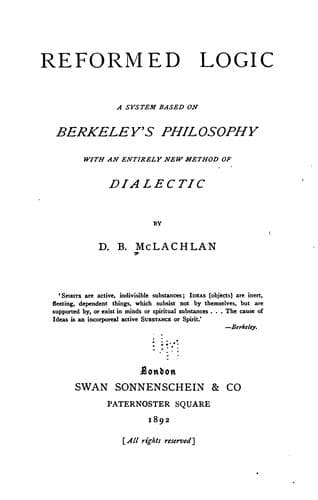
Reformed Logic: A System Based on Berkeley's Philosophy with an Entirely New Method of DialecticMcLachlan, D. B.
Philosophy
Reformed Logic: A System Based on Berkeley's Philosophy with an Entirely New Method of Dialectic
McLachlan, D. B.
Logic
It will be convenient to suppose that the modifications to which it
refers are solely due to the observing mind, as the most conspicuous
and comprehensive really are, but some of the minor perspective
changes are due to the noumenon of the object.
We have first to get a criterion of perspective perfection. What this
shall be is to some extent a matter of convention. The standard I
shall adopt is, that an object of a nature to be perceptible to all
the senses would be most perfect if within reach of touch. If it can
be heard it is then heard at its loudest--this is correct enough for
our purpose,--if it can be seen it is then seen at its largest and
brightest. This is Perspective Completeness at the Tactual Range. It
means the closest contact of noumenon and subject, compatible with
clear definition in perception.
Now let us exert energy and disarrange a group. Those things that were
or might have been tangible in the former position, are no longer so,
but they may still be seen, heard, or even smelt. The bright colours
have however somewhat faded, the size has shrunk, some of the details
are lost. Here is a lapse from perspective completeness. It is
indicated, not as in the first two categories by mechanical cutting
away of mass and circumstance, but by deterioration all over the
object. We seem to be thrown out of focus in relation to it, and the
perspective degradation may increase until the object has dwindled to
a speck and finally disappears altogether.
The judgment in this category consists in observing the kind and
degree of degradation to which things are liable in perspection. In
addition to change in size, brightness, detail and loudness, which
have been already mentioned, occultation as in the second category
can be used as an indirect datum. An object which eclipses another is
invariably more perfect perspectively than the object eclipsed.
The motion of objects has also to be taken into account. As objects
degrade their movements slacken, and recover power as the objects are
restored.
By attending to all these indications and checking each by the rest,
we have the elements of a fairly accurate inference as to comparative
perspective condition. We have constant practice in this sort of
thought with frequent opportunities of verifying our conclusions;
penalties are annexed to failure and rewards to success. It is no
wonder then that in the course of years we become expert in judging of
perspective condition, so that when confronted with a natural group
we can estimate almost instantly the degree in which each object falls
short of perspective integrity.
Public-domain text, read in full here on John Shaqi.
Reviews
Reviews
No reviews yet
Be the first to share your thoughts on this work.
Join the Discussion
Join the discussion
Sign in to leave a comment or review.
Sign InorCreate an account