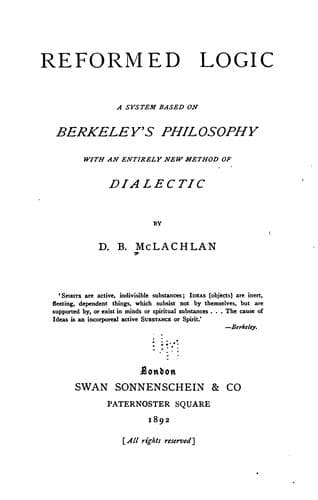
Reformed Logic: A System Based on Berkeley's Philosophy with an Entirely New Method of DialecticMcLachlan, D. B.
Philosophy
Reformed Logic: A System Based on Berkeley's Philosophy with an Entirely New Method of Dialectic
McLachlan, D. B.
Logic
The result of this practice is that on perceiving a natural group
of many objects, we graduate them according to the perspective
deterioration which each exhibits, and for greater precision we figure
the perspective difference as an interval between the objects--an
imaginary interval modelled on the true interval of association. The
object on a distant horizon is visually as near as the ground we can
touch by stooping, but in this imaginary group the former is placed
at the far end of the line and the latter at the near end, and between
them are ranged the other objects each at a point corresponding
to what we suppose to be its perspective distance. That is how a
landscape acquires depth. Space outwards is an ideal imitation of
real lateral interval. It is the measure and expression of perspective
defacement.
From what has been said it follows that the near objects will be
relatively large, clear, and lively in motion, while the far will
be small, dull, and slow, but this rule is liable to many exceptions
which can only be learnt by experience.
On the analogy of the other forms of inference--which consist in
completing imperfect things by reference to others more perfect--the
essence of an argument in perspection is the power to imagine an
object which is perspectively defective, brought up to the tactual
range and displaying all the qualities it would possess in that
position. This is done by comparing it with the idea of the same or
a similar object experienced at the tactual range; and is done for an
ulterior purpose, like all other intellectual operations. A great part
of our material happiness consists in the exercise of the short senses
(taste, touch and smell), and the chief use of perspective reasoning
is to enable us to judge of the energy required to bring a distant
object near for close perception. We have therefore to observe our
energic fluctuations in conjunction with perspective change, if we
would extract the utmost practical benefit from this category. The
perspective inferences are none the less useful after we discover that
they are not intuitions, and that the completeness we imaginatively
assign to distant objects has no existence until we exert the
corresponding energy.
A landscape being rendered perspective we can determine the
perspective state of any new object that may enter it, by reference to
the objects adjoining it, and this though the object be of a species
quite unknown to us and which therefore, by itself, would afford no
clue to its perspective distance.
Public-domain text, read in full here on John Shaqi.
Reviews
Reviews
No reviews yet
Be the first to share your thoughts on this work.
Join the Discussion
Join the discussion
Sign in to leave a comment or review.
Sign InorCreate an account