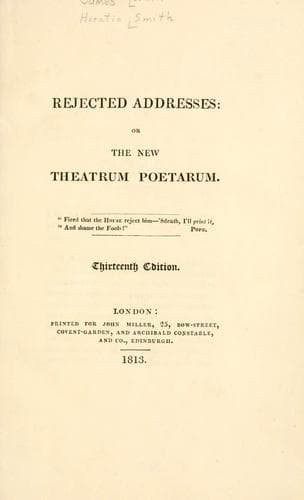
Rejected Addresses; Or, The New Theatrum PoetarumSmith, James
General
Rejected Addresses; Or, The New Theatrum Poetarum
Smith, James
Parodies
He had, moreover, large grey eyes, thick features, and an inexpressive
countenance. In talking, he had a disagreeable habit of drawing the
fore-finger of his right hand across his tight eye-lid. He affected, in
conversation, a sort of dandified, drawling tone: young Harlowe, the
artist, did the same. A foreigner who had but slight knowledge of the
English language might have concluded, from their cadences, that they
were little better than fools—“just a born goose,” as Terry the actor
used to say. Lewis died on his passage homeward from Jamaica, owing to a
dose of James’s powders injudiciously administered by “his own mere
motion.” He wrote various plays, with various success, he had admirable
notions of dramatic construction, but the goodness of his scenes and
incidents was marred by the badness of his dialogue.
{65} “Mr. Coleridge will not, we fear, be as much entertained as we were
with his ‘Playhouse Musings,’ which begin with characteristic pathos and
simplicity, and put us much in mind of the affecting story of old
Poulter’s mare.”—_Quarterly Review_.
“‘Playhouse Musings,’ by Mr. Coleridge, a piece which is unquestionably
Lakish, though we cannot say that we recognise in it any of the peculiar
traits of that powerful and misdirected genius whose name it has
borrowed. We rather think, however, that the tuneful brotherhood will
consider it as a respectable eclogue.”—JEFFREY, _Edinburgh Review_.
{66} “He of Blackfriars’ Road,” viz. the late Rev. Rowland Hill, who is
said to have preached a sermon congratulating his congregation on the
catastrophe. [See before:—
Meux’s new brewhouse shows the light,
Rowland Hill’s Chapel, and the height
Where Patent Shot they sell.]
{67} “Oh, Mr. Whitbread!” Sir William Grant, then Master of the Rolls,
repeated this passage aloud at a Lord Mayor’s dinner, to the no small
astonishment of the writer, who happened to sit within ear-shot.
{68} “Padmanaba,” viz., in a pantomime called _Harlequin in Padmanaba_.
This elephant [Chunee], some years afterwards, was exhibited over Exeter
’Change, where, the reader will remember, it was found necessary [March,
1826] to destroy the poor animal by discharges of musketry. When he made
his entrance in the pantomime above mentioned, Johnson, the machinist of
the rival house, exclaimed, “I should be very sorry if I could not make a
better elephant than that!” Johnson was right: we go to the theatre to
be pleased with the skill of the imitator, and not to look at the
reality.
{69} “‘A New Halfpenny Ballad,’ by a Pic-Nic Poet, is a good imitation
of what was not worth imitating—that tremendous mixture of vulgarity,
nonsense, impudence, and miserable puns, which, under the name of
humorous songs, rouses our polite audiences to a far higher pitch of
rapture than Garrick or Siddons ever was able to inspire.”—JEFFREY,
_Edinburgh Review_.
Public-domain text, read in full here on John Shaqi.
Reviews
Reviews
No reviews yet
Be the first to share your thoughts on this work.
Elsewhere in the archive
Join the Discussion
Join the discussion
Sign in to leave a comment or review.
Sign InorCreate an account