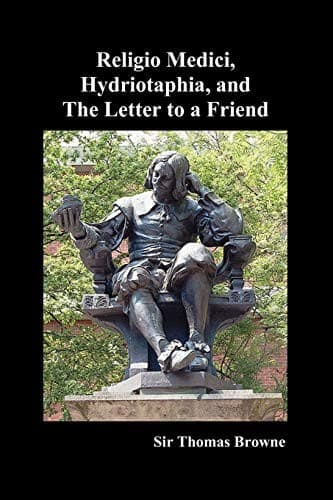
Religio Medici, Hydriotaphia, and the Letter to a FriendBrowne, Thomas, Sir
Religion
Religio Medici, Hydriotaphia, and the Letter to a Friend
Browne, Thomas, Sir
Christian ethics; Christian life; Essays; Funeral rites and ceremonies; Medical ethics; Medicine -- History; Religion and medicine
Lastly, if length of days be thy portion, make it not thy expectation.
Reckon not upon long life; but live always beyond thy account. He that
so often surviveth his expectation lives many lives, and will scarce
complain of the shortness of his days. Time past is gone like a shadow;
make times to come present; conceive that near which may be far off.
Approximate thy latter times by present apprehensions of them: be like
a neighbour unto death, and think there is but little to come. And
since there is something in us that must still live on, join both lives
together, unite them in thy thoughts and actions, and live in one but
for the other. He who thus ordereth the purposes of this life, will
never be far from the next, and is in some manner already in it, by a
happy conformity and close apprehension of it.
NOTES TO THE RELIGIO MEDICI.
1. It was a proverb, “Ubi tres medici duo athei.”
2. A Latinised word meaning a taunt (impropero.)
3. The synod of Dort was held in 1619 to discuss the doctrines of
Arminius. It ended by condemning them.
4. Hallam, commenting on this passage, says--“That Jesuit must be a
disgrace to his order who would have asked more than such a concession
to secure a proselyte--the right of interpreting whatever was written,
and of supplying whatever was not.”--_Hist. England_, vol. ii. p. 74.
5. See the statute of the Six Articles (31 Hen. VIII. c. 14), which
declared that transubstantiation, communion in one kind, celibacy
of the clergy, vows of widowhood, private masses, and auricular
confession, were part of the law of England.
6. In the year 1606, when the Jesuits were expelled from Venice, Pope
Paul V. threatened to excommunicate that republic. A most violent
quarrel ensued, which was ultimately settled by the mediation of France.
7. Alluding to the story of Œdipus solving the riddle proposed by the
Sphynx.
8. The nymph Arethusa was changed by Diana into a fountain, and was
said to have flowed under the sea from Elis to the fountain of Arethusa
near Syracuse.--Ov. _Met._ lib. v. fab. 8.
9. These heretics denied the immortality of the soul, but held that it
was recalled to life with the body. Origen came from Egypt to confute
them, and is said to have succeeded. (See Mosh. _Eccl. Hist._, lib. i.
c. 5. sec. 16.) Pope John XXII. afterwards adopted it.
10. A division from the Greek διχοτομια.
11. The brain.
12. A faint resemblance, from the Latin _adumbro_, to shade.
13. Alluding to the idea Sir T. Browne often expresses, that an oracle
was the utterance of the devil.
14. To fathom, from Latin _profundus_.
15. Beginning from the Latin _efficio_.
16. Galen’s great work.
17. John de Monte Regio made a wooden eagle that, when the emperor was
entering Nuremburg, flew to meet him, and hovered over his head. He
also made an iron fly that, when at dinner, he was able to make start
from under his hand, and fly round the table.--See De Bartas, 6^{me}
jour 1^{me} semaine.
18. Hidden, from the Greek κρυπτω.
Public-domain text, read in full here on John Shaqi.
Reviews
Reviews
No reviews yet
Be the first to share your thoughts on this work.
Elsewhere in the archive
Join the Discussion
Join the discussion
Sign in to leave a comment or review.
Sign InorCreate an account