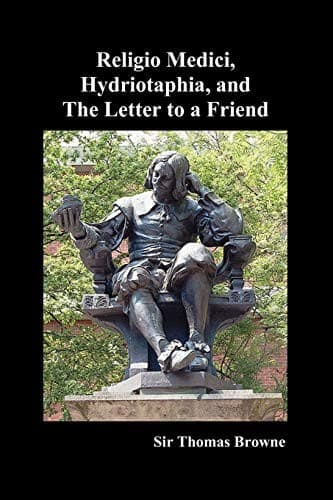
Religio Medici, Hydriotaphia, and the Letter to a FriendBrowne, Thomas, Sir
Religion
Religio Medici, Hydriotaphia, and the Letter to a Friend
Browne, Thomas, Sir
Christian ethics; Christian life; Essays; Funeral rites and ceremonies; Medical ethics; Medicine -- History; Religion and medicine
44. Oracles were said to have ceased when Christ came, the reply to
Augustus on the subject being the last--
“Me puer Hebræus divos Deus ipse gubernans
Cedere sede jubet tristemque redire sub Orcum
Aris ergo de hinc tacitus discedito nostris.”
45. An historian who wrote “De Rebus Indicis.” He is cited by Pliny,
Strabo, and Josephus.
46. Alluding to the popular superstition that infant children were
carried off by fairies, and others left in their places.
47. Who is said to have lived without meat, on the smell of a rose.
48. “Essentiæ rationalis immortalis.”
49. St Augustine, De Civ. Dei, lib. x., cc. 9, 19, 32.
50. That which includes everything is opposed to nullity.
51. An inversion of the parts of an antithesis.
52. St Augustine--“Homily on Genesis.”
53. Sir T. Browne wrote a dialogue between two twins in the womb
respecting the world into which they were going!
54. Refinement.
55. Constitution another form of temperament.
56. The Jewish computation for fifty years.
57. Saturn revolves once in thirty years.
58. Christian IV., of Denmark, who reigned from 1588-1647.
59. Æson was the father of Jason. By bathing in a bath prepared for him
by Medæa with some magic spells, he became young again. Ovid describes
the bath and its ingredients, _Met._, lib. vii. fab. 2.
60. Alluding to the rabbinical tradition that the world would last for
6000 years, attributed to Elias, and cited in the Talmud.
61. Zeno was the founder of the Stoics.
62. Referring to a passage in Suetonius, Vit. J. Cæsar, sec
87:--“Aspernatus tam lentum mortis genus subitam sibi celeremque
optaverat.”
63. In holding
“Mors ultima pœna est,
Nec metuenda viris.”
64. The period when the moon is in conjunction and obscured by the sun.
65. One of the judges of hell.
66. To select some great man for our ideal, and always to act as if he
was present with us. See Seneca, lib. i. Ep. 11.
67. Sir T. Browne seems to have made various experiments in this
subject. D’Israeli refers to it in his “Curiosities of Literature.” Dr
Power, a friend of Sir T. Browne, with whom he corresponded, gives a
receipt for the process.
68. The celebrated Greek philosopher who taught that the sun was a mass
of heated stone, and various other astronomical doctrines. Some critics
say Anaxarchus is meant here.
69. See Milton’s “Paradise Lost,” lib. I. 254--
“The mind is its own place, and in itself
Can make a heaven of hell, a hell of heaven.”
And also Lucretius--
“Hic Acherusia fit stultorum denique vita.”--iii. 1023.
70. Keck says here--“So did they all, as Lactantius has observed
at large. Aristotle is said to have been guilty of great vanity in
his clothes, of incontinency, and of unfaithfulness to his master,
Alexander II.”
71. Phalaris, king of Agrigentum, who, when Perillus made a brazen bull
in which to kill criminals, placed him in it to try its effects.
72. Their maxim was
Public-domain text, read in full here on John Shaqi.
Reviews
Reviews
No reviews yet
Be the first to share your thoughts on this work.
Elsewhere in the archive
Join the Discussion
Join the discussion
Sign in to leave a comment or review.
Sign InorCreate an account