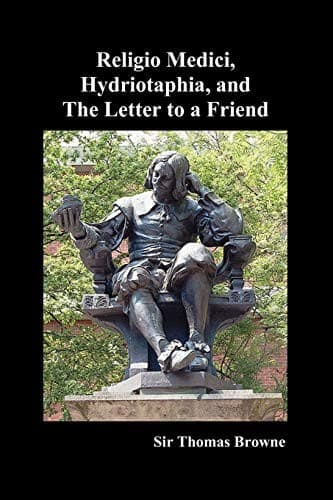
Religio Medici, Hydriotaphia, and the Letter to a FriendBrowne, Thomas, Sir
Religion
Religio Medici, Hydriotaphia, and the Letter to a Friend
Browne, Thomas, Sir
Christian ethics; Christian life; Essays; Funeral rites and ceremonies; Medical ethics; Medicine -- History; Religion and medicine
There be many excellent strains in that poet, wherewith his stoical
genius hath liberally supplied him: and truly there are singular pieces
in the philosophy of Zeno,[61] and doctrine of the stoics, which I
perceive, delivered in a pulpit, pass for current divinity: yet herein
are they in extremes, that can allow a man to be his own assassin, and
so highly extol the end and suicide of Cato. This is indeed not to
fear death, but yet to be afraid of life. It is a brave act of valour
to contemn death; but, where life is more terrible than death, it is
then the truest valour to dare to live: and herein religion hath taught
us a noble example; for all the valiant acts of Curtius, Scævola, or
Codrus, do not parallel, or match, that one of Job; and sure there is
no torture to the rack of a disease, nor any poniards in death itself,
like those in the way or prologue unto it. “_Emori nolo, sed me esse
mortuum nihil curo_;” I would not die, but care not to be dead. Were I
of Cæsar’s religion,[62] I should be of his desires, and wish rather to
go off at one blow, than to be sawed in pieces by the grating torture
of a disease. Men that look no further than their outsides, think
health an appurtenance unto life, and quarrel with their constitutions
for being sick; but I, that have examined the parts of man, and know
upon what tender filaments that fabrick hangs, do wonder that we are
not always so; and, considering the thousand doors that lead to death,
do thank my God that we can die but once. ’Tis not only the mischief of
diseases, and the villany of poisons, that make an end of us; we vainly
accuse the fury of guns, and the new inventions of death:--it is in
the power of every hand to destroy us, and we are beholden unto every
one we meet, he doth not kill us. There is therefore but one comfort
left, that though it be in the power of the weakest arm to take away
life, it is not in the strongest to deprive us of death. God would
not exempt himself from that; the misery of immortality in the flesh
he undertook not, that was immortal. Certainly there is no happiness
within this circle of flesh; nor is it in the opticks of these eyes
to behold felicity. The first day of our jubilee is death; the devil
hath therefore failed of his desires; we are happier with death than
we should have been without it: there is no misery but in himself,
where there is no end of misery; and so indeed, in his own sense, the
stoic is in the right.[63] He forgets that he can die, who complains of
misery: we are in the power of no calamity while death is in our own.
Public-domain text, read in full here on John Shaqi.
Reviews
Reviews
No reviews yet
Be the first to share your thoughts on this work.
Join the Discussion
Join the discussion
Sign in to leave a comment or review.
Sign InorCreate an account