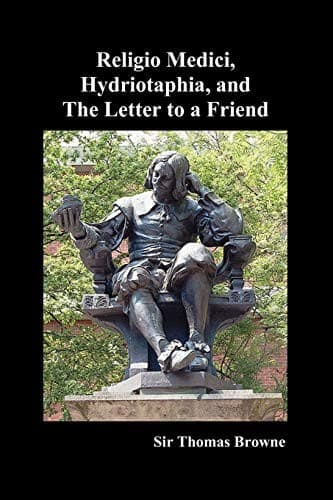
Religio Medici, Hydriotaphia, and the Letter to a FriendBrowne, Thomas, Sir
Religion
Religio Medici, Hydriotaphia, and the Letter to a Friend
Browne, Thomas, Sir
Christian ethics; Christian life; Essays; Funeral rites and ceremonies; Medical ethics; Medicine -- History; Religion and medicine
_Sect._ 45.--Now, besides this literal and positive kind of death,
there are others whereof divines make mention, and those, I think,
not merely metaphorical, as mortification, dying unto sin and the
world. Therefore, I say, every man hath a double horoscope; one of his
humanity,--his birth, another of his Christianity,--his baptism: and
from this do I compute or calculate my nativity; not reckoning those
_horæ combustæ_,[64] and odd days, or esteeming myself anything, before
I was my Saviour’s and enrolled in the register of Christ. Whosoever
enjoys not this life, I count him but an apparition, though he wear
about him the sensible affections of flesh. In these moral acceptions,
the way to be immortal is to die daily; nor can I think I have the
true theory of death, when I contemplate a skull or behold a skeleton
with those vulgar imaginations it casts upon us. I have therefore
enlarged that common _memento mori_ into a more Christian memorandum,
_memento quatuor novissima_,--those four inevitable points of us all,
death, judgment, heaven, and hell. Neither did the contemplations
of the heathens rest in their graves, without a further thought, of
Rhadamanth[65] or some judicial proceeding after death, though in
another way, and upon suggestion of their natural reasons. I cannot but
marvel from what sibyl or oracle they stole the prophecy of the world’s
destruction by fire, or whence Lucan learned to say--
“_Communis mundo superest rogus, ossibus astra
Misturus----_”[N]
[N] _Pharsalia_, vii. 814.
There yet remains to th’ world one common fire,
Wherein our bones with stars shall make one pyre.
I believe the world grows near its end; yet is neither old nor decayed,
nor will ever perish upon the ruins of its own principles. As the work
of creation was above nature, so its adversary, annihilation; without
which the world hath not its end, but its mutation. Now, what force
should be able to consume it thus far, without the breath of God, which
is the truest consuming flame, my philosophy cannot inform me. Some
believe there went not a minute to the world’s creation, nor shall
there go to its destruction; those six days, so punctually described,
make not to them one moment, but rather seem to manifest the method and
idea of that great work of the intellect of God than the manner how he
proceeded in its operation. I cannot dream that there should be at the
last day any such judicial proceeding, or calling to the bar, as indeed
the Scripture seems to imply, and the literal commentators do conceive:
for unspeakable mysteries in the Scriptures are often delivered in
a vulgar and illustrative way, and, being written unto man, are
delivered, not as they truly are, but as they may be understood;
wherein, notwithstanding, the different interpretations according to
different capacities may stand firm with our devotion, nor be any way
prejudicial to each single edification.
Public-domain text, read in full here on John Shaqi.
Reviews
Reviews
No reviews yet
Be the first to share your thoughts on this work.
Join the Discussion
Join the discussion
Sign in to leave a comment or review.
Sign InorCreate an account