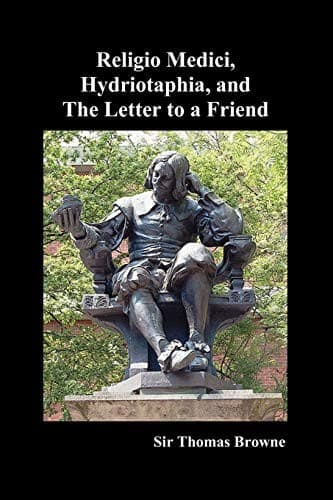
Religio Medici, Hydriotaphia, and the Letter to a FriendBrowne, Thomas, Sir
Religion
Religio Medici, Hydriotaphia, and the Letter to a Friend
Browne, Thomas, Sir
Christian ethics; Christian life; Essays; Funeral rites and ceremonies; Medical ethics; Medicine -- History; Religion and medicine
_Sect._ 47.--This is the day that must make good that great attribute
of God, his justice; that must reconcile those unanswerable doubts
that torment the wisest understandings; and reduce those seeming
inequalities and respective distributions in this world, to an equality
and recompensive justice in the next. This is that one day, that shall
include and comprehend all that went before it; wherein, as in the
last scene, all the actors must enter, to complete and make up the
catastrophe of this great piece. This is the day whose memory hath,
only, power to make us honest in the dark, and to be virtuous without
a witness. “_Ipsa sui pretium virtus sibi_,” that virtue is her own
reward, is but a cold principle, and not able to maintain our variable
resolutions in a constant and settled way of goodness. I have practised
that honest artifice of Seneca,[66] and, in my retired and solitary
imaginations to detain me from the foulness of vice, have fancied to
myself the presence of my dear and worthiest friends, before whom I
should lose my head rather than be vicious; yet herein I found that
there was nought but moral honesty; and this was not to be virtuous
for his sake who must reward us at the last. I have tried if I could
reach that great resolution of his, to be honest without a thought of
heaven or hell; and, indeed I found, upon a natural inclination, and
inbred loyalty unto virtue, that I could serve her without a livery,
yet not in that resolved and venerable way, but that the frailty of my
nature, upon an easy temptation, might be induced to forget her. The
life, therefore, and spirit of all our actions is the resurrection,
and a stable apprehension that our ashes shall enjoy the fruit of our
pious endeavours; without this, all religion is a fallacy, and those
impieties of Lucian, Euripides, and Julian, are no blasphemies, but
subtile verities; and atheists have been the only philosophers.
Public-domain text, read in full here on John Shaqi.
Reviews
Reviews
No reviews yet
Be the first to share your thoughts on this work.
Join the Discussion
Join the discussion
Sign in to leave a comment or review.
Sign InorCreate an account