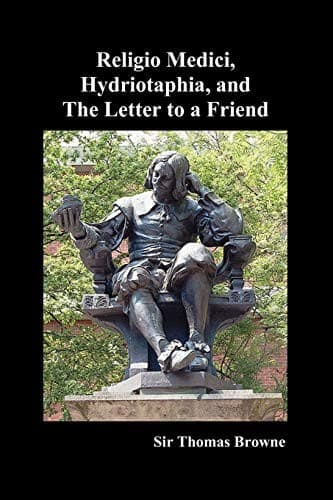
Religio Medici, Hydriotaphia, and the Letter to a FriendBrowne, Thomas, Sir
Religion
Religio Medici, Hydriotaphia, and the Letter to a Friend
Browne, Thomas, Sir
Christian ethics; Christian life; Essays; Funeral rites and ceremonies; Medical ethics; Medicine -- History; Religion and medicine
_Sect._ 48.--How shall the dead arise, is no question of my faith; to
believe only possibilities is not faith, but mere philosophy. Many
things are true in divinity, which are neither inducible by reason
nor confirmable by sense; and many things in philosophy confirmable
by sense, yet not inducible by reason. Thus it is impossible, by any
solid or demonstrative reasons, to persuade a man to believe the
conversion of the needle to the north; though this be possible and
true, and easily credible, upon a single experiment unto the sense. I
believe that our estranged and divided ashes shall unite again; that
our separated dust, after so many pilgrimages and transformations into
the parts of minerals, plants, animals, elements, shall, at the voice
of God, return into their primitive shapes, and join again to make up
their primary and predestinate forms. As at the creation there was a
separation of that confused mass into its pieces; so at the destruction
thereof there shall be a separation into its distinct individuals. As,
at the creation of the world, all the distinct species that we behold
lay involved in one mass, till the fruitful voice of God separated this
united multitude into its several species, so, at the last day, when
those corrupted relicks shall be scattered in the wilderness of forms,
and seem to have forgot their proper habits, God, by a powerful voice,
shall command them back into their proper shapes, and call them out
by their single individuals. Then shall appear the fertility of Adam,
and the magick of that sperm that hath dilated into so many millions.
I have often beheld, as a miracle, that artificial resurrection and
revivification of mercury, how being mortified into a thousand shapes,
it assumes again its own, and returns into its numerical self. Let us
speak naturally, and like philosophers. The forms of alterable bodies
in these sensible corruptions perish not; nor, as we imagine, wholly
quit their mansions; but retire and contract themselves into their
secret and unaccessible parts; where they may best protect themselves
from the action of their antagonist. A plant or vegetable consumed
to ashes to a contemplative and school-philosopher seems utterly
destroyed, and the form to have taken his leave for ever; but to a
sensible artist the forms are not perished, but withdrawn into their
incombustible part, where they lie secure from the action of that
devouring element. This is made good by experience, which can from
the ashes of a plant revive the plant, and from its cinders recall
it into its stalk and leaves again.[67] What the art of man can do
in these inferior pieces, what blasphemy is it to affirm the finger
of God cannot do in those more perfect and sensible structures? This
is that mystical philosophy, from whence no true scholar becomes an
atheist, but from the visible effects of nature grows up a real divine,
and beholds not in a dream, as Ezekiel, but in an ocular and visible
Public-domain text, read in full here on John Shaqi.
Reviews
Reviews
No reviews yet
Be the first to share your thoughts on this work.
Elsewhere in the archive
Join the Discussion
Join the discussion
Sign in to leave a comment or review.
Sign InorCreate an account