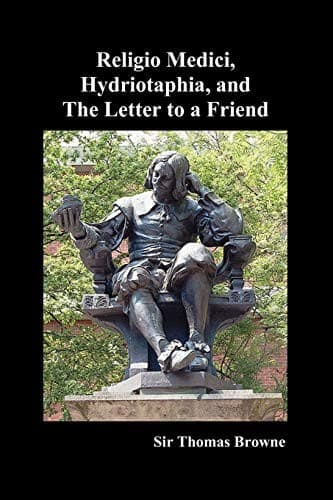
Religio Medici, Hydriotaphia, and the Letter to a FriendBrowne, Thomas, Sir
Religion
Religio Medici, Hydriotaphia, and the Letter to a Friend
Browne, Thomas, Sir
Christian ethics; Christian life; Essays; Funeral rites and ceremonies; Medical ethics; Medicine -- History; Religion and medicine
rules of our philosophy, and make all good by a more absolute piece of
opticks.
_Sect._ 50.--I cannot tell how to say that fire is the essence of
hell; I know not what to make of purgatory, or conceive a flame that
can either prey upon, or purify the substance of a soul. Those flames
of sulphur, mentioned in the scriptures, I take not to be understood
of this present hell, but of that to come, where fire shall make up
the complement of our tortures, and have a body or subject whereon to
manifest its tyranny. Some who have had the honour to be textuary in
divinity are of opinion it shall be the same specifical fire with ours.
This is hard to conceive, yet can I make good how even that may prey
upon our bodies, and yet not consume us: for in this material world,
there are bodies that persist invincible in the powerfulest flames; and
though, by the action of fire, they fall into ignition and liquation,
yet will they never suffer a destruction. I would gladly know how
Moses, with an actual fire, calcined or burnt the golden calf into
powder: for that mystical metal of gold, whose solary and celestial
nature I admire, exposed unto the violence of fire, grows only hot,
and liquefies, but consumeth not; so when the consumable and volatile
pieces of our bodies shall be refined into a more impregnable and fixed
temper, like gold, though they suffer from the action of flames, they
shall never perish, but lie immortal in the arms of fire. And surely,
if this flame must suffer only by the action of this element, there
will many bodies escape; and not only heaven, but earth will not be
at an end, but rather a beginning. For at present it is not earth,
but a composition of fire, water, earth, and air; but at that time,
spoiled of these ingredients, it shall appear in a substance more like
itself, its ashes. Philosophers that opinioned the world’s destruction
by fire, did never dream of annihilation, which is beyond the power of
sublunary causes; for the last and proper action of that element is but
vitrification, or a reduction of a body into glass; and therefore some
of our chymicks facetiously affirm, that, at the last fire, all shall
be crystalized and reverberated into glass, which is the utmost action
of that element. Nor need we fear this term, annihilation, or wonder
that God will destroy the works of his creation: for man subsisting,
who is, and will then truly appear, a microcosm, the world cannot be
said to be destroyed. For the eyes of God, and perhaps also of our
glorified selves, shall as really behold and contemplate the world, in
its epitome or contracted essence, as now it doth at large and in its
dilated substance. In the seed of a plant, to the eyes of God, and to
the understanding of man, there exists, though in an invisible way,
the perfect leaves, flowers, and fruit thereof; for things that are in
_posse_ to the sense, are actually existent to the understanding. Thus
God beholds all things, who contemplates as fully his works in their
Public-domain text, read in full here on John Shaqi.
Reviews
Reviews
No reviews yet
Be the first to share your thoughts on this work.
Elsewhere in the archive
Join the Discussion
Join the discussion
Sign in to leave a comment or review.
Sign InorCreate an account