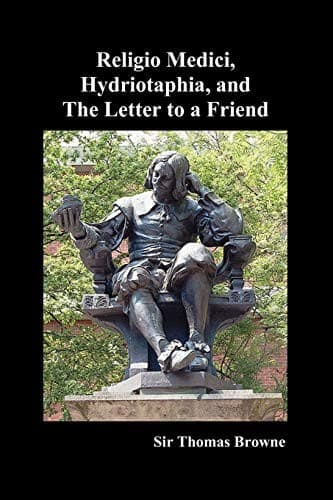
Religio Medici, Hydriotaphia, and the Letter to a FriendBrowne, Thomas, Sir
Religion
Religio Medici, Hydriotaphia, and the Letter to a Friend
Browne, Thomas, Sir
Christian ethics; Christian life; Essays; Funeral rites and ceremonies; Medical ethics; Medicine -- History; Religion and medicine
object, the types of his resurrection.
_Sect._ 49.--Now, the necessary mansions of our restored selves are
those two contrary and incompatible places we call heaven and hell.
To define them, or strictly to determine what and where these are,
surpasseth my divinity. That elegant apostle, which seemed to have
a glimpse of heaven, hath left but a negative description thereof;
which “neither eye hath seen, nor ear hath heard, nor can enter into
the heart of man:” he was translated out of himself to behold it;
but, being returned into himself, could not express it. Saint John’s
description by emeralds, chrysolites, and precious stones, is too weak
to express the material heaven we behold. Briefly, therefore, where
the soul hath the full measure and complement of happiness; where
the boundless appetite of that spirit remains completely satisfied
that it can neither desire addition nor alteration; that, I think, is
truly heaven: and this can only be in the enjoyment of that essence,
whose infinite goodness is able to terminate the desires of itself,
and the unsatiable wishes of ours. Wherever God will thus manifest
himself, there is heaven, though within the circle of this sensible
world. Thus, the soul of man may be in heaven anywhere, even within
the limits of his own proper body; and when it ceaseth to live in the
body it may remain in its own soul, that is, its Creator. And thus
we may say that Saint Paul, whether in the body or out of the body,
was yet in heaven. To place it in the empyreal, or beyond the tenth
sphere, is to forget the world’s destruction; for when this sensible
world shall be destroyed, all shall then be here as it is now there,
an empyreal heaven, a _quasi_ vacuity; when to ask where heaven is, is
to demand where the presence of God is, or where we have the glory of
that happy vision. Moses, that was bred up in all the learning of the
Egyptians, committed a gross absurdity in philosophy, when with these
eyes of flesh he desired to see God, and petitioned his Maker, that is
truth itself, to a contradiction. Those that imagine heaven and hell
neighbours, and conceive a vicinity between those two extremes, upon
consequence of the parable, where Dives discoursed with Lazarus, in
Abraham’s bosom, do too grossly conceive of those glorified creatures,
whose eyes shall easily out-see the sun, and behold without perspective
the extremest distances: for if there shall be, in our glorified
eyes, the faculty of sight and reception of objects, I could think
the visible species there to be in as unlimitable a way as now the
intellectual. I grant that two bodies placed beyond the tenth sphere,
or in a vacuity, according to Aristotle’s philosophy, could not behold
each other, because there wants a body or medium to hand and transport
the visible rays of the object unto the sense; but when there shall
be a general defect of either medium to convey, or light to prepare
and dispose that medium, and yet a perfect vision, we must suspend the
Public-domain text, read in full here on John Shaqi.
Reviews
Reviews
No reviews yet
Be the first to share your thoughts on this work.
Elsewhere in the archive
Join the Discussion
Join the discussion
Sign in to leave a comment or review.
Sign InorCreate an account