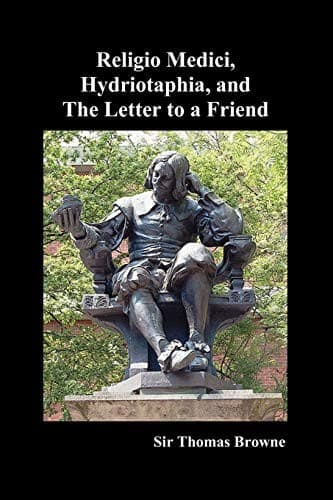
Religio Medici, Hydriotaphia, and the Letter to a FriendBrowne, Thomas, Sir
Religion
Religio Medici, Hydriotaphia, and the Letter to a Friend
Browne, Thomas, Sir
Christian ethics; Christian life; Essays; Funeral rites and ceremonies; Medical ethics; Medicine -- History; Religion and medicine
moreover, that there is a phytognomy, or physiognomy, not only of men,
but of plants and vegetables; and is every one of them some outward
figures which hang as signs or bushes of their inward forms. The finger
of God hath left an inscription upon all his works, not graphical, or
composed of letters, but of their several forms, constitutions, parts,
and operations, which, aptly joined together, do make one word that
doth express their natures. By these letters God calls the stars by
their names; and by this alphabet Adam assigned to every creature a
name peculiar to its nature. Now, there are, besides these characters
in our faces, certain mystical figures in our hands, which I dare not
call mere dashes, strokes _à la volee_ or at random, because delineated
by a pencil that never works in vain; and hereof I take more particular
notice, because I carry that in mine own hand which I could never read
of nor discover in another. Aristotle, I confess, in his acute and
singular book of physiognomy, hath made no mention of chiromancy:[80]
yet I believe the Egyptians, who were nearer addicted to those abstruse
and mystical sciences, had a knowledge therein: to which those vagabond
and counterfeit Egyptians did after[81] pretend, and perhaps retained
a few corrupted principles, which sometimes might verify their
prognosticks.
It is the common wonder of all men, how, among so many millions of
faces, there should be none alike: now, contrary, I wonder as much
how there should be any. He that shall consider how many thousand
several words have been carelessly and without study composed out of
twenty-four letters; withal, how many hundred lines there are to be
drawn in the fabrick of one man; shall easily find that this variety
is necessary: and it will be very hard that they shall so concur as to
make one portrait like another. Let a painter carelessly limn out a
million of faces, and you shall find them all different; yes, let him
have his copy before him, yet, after all his art, there will remain
a sensible distinction: for the pattern or example of everything is
the perfectest in that kind, whereof we still come short, though we
transcend or go beyond it; because herein it is wide, and agrees not
in all points unto its copy. Nor doth the similitude of creatures
disparage the variety of nature, nor any way confound the works of God.
For even in things alike there is diversity; and those that do seem to
accord do manifestly disagree. And thus is man like God; for, in the
same things that we resemble him we are utterly different from him.
There was never anything so like another as in all points to concur;
there will ever some reserved difference slip in, to prevent the
identity; without which two several things would not be alike, but the
same, which is impossible.
Public-domain text, read in full here on John Shaqi.
Reviews
Reviews
No reviews yet
Be the first to share your thoughts on this work.
Elsewhere in the archive
Join the Discussion
Join the discussion
Sign in to leave a comment or review.
Sign InorCreate an account