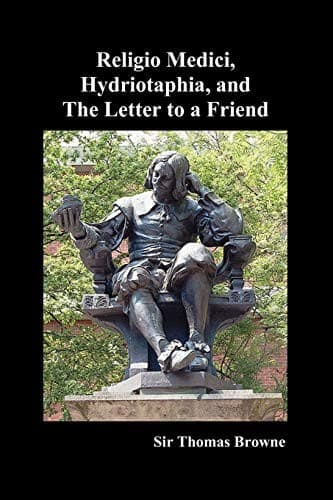
Religio Medici, Hydriotaphia, and the Letter to a FriendBrowne, Thomas, Sir
Religion
Religio Medici, Hydriotaphia, and the Letter to a Friend
Browne, Thomas, Sir
Christian ethics; Christian life; Essays; Funeral rites and ceremonies; Medical ethics; Medicine -- History; Religion and medicine
St Paul, that calls the Cretians liars, doth it but indirectly, and
upon quotation of their own poet.[88] It is as bloody a thought in one
way as Nero’s was in another.[89] For by a word we wound a thousand,
and at one blow assassin the honour of a nation. It is as complete a
piece of madness to miscall and rave against the times; or think to
recall men to reason by a fit of passion. Democritus, that thought to
laugh the times into goodness, seems to me as deeply hypochondriack
as Heraclitus, that bewailed them. It moves not my spleen to behold
the multitude in their proper humours; that is, in their fits of
folly and madness, as well understanding that wisdom is not profaned
unto the world; and it is the privilege of a few to be virtuous. They
that endeavour to abolish vice destroy also virtue; for contraries,
though they destroy one another, are yet the life of one another. Thus
virtue (abolish vice) is an idea. Again, the community of sin doth
not disparage goodness; for, when vice gains upon the major part,
virtue, in whom it remains, becomes more excellent, and, being lost
in some, multiplies its goodness in others, which remain untouched,
and persist entire in the general inundation. I can therefore behold
vice without a satire, content only with an admonition, or instructive
reprehension; for noble natures, and such as are capable of goodness,
are railed into vice, that might as easily be admonished into virtue;
and we should be all so far the orators of goodness as to protect her
from the power of vice, and maintain the cause of injured truth. No man
can justly censure or condemn another; because, indeed, no man truly
knows another. This I perceive in myself; for I am in the dark to all
the world, and my nearest friends behold me but in a cloud. Those that
know me but superficially think less of me than I do of myself; those
of my near acquaintance think more; God who truly knows me, knows
that I am nothing: for he only beholds me, and all the world, who
looks not on us through a derived ray, or a trajection of a sensible
species, but beholds the substance without the help of accidents, and
the forms of things, as we their operations. Further, no man can judge
another, because no man knows himself; for we censure others but as
they disagree from that humour which we fancy laudable in ourselves,
and commend others but for that wherein they seem to quadrate and
consent with us. So that in conclusion, all is but that we all condemn,
self-love. ’Tis the general complaint of these times, and perhaps of
those past, that charity grows cold; which I perceive most verified
in those which do most manifest the fires and flames of zeal; for it
is a virtue that best agrees with coldest natures, and such as are
complexioned for humility. But how shall we expect charity towards
others, when we are uncharitable to ourselves? “Charity begins at
home,” is the voice of the world; yet is every man his greatest enemy,
and as it were his own executioner.
Public-domain text, read in full here on John Shaqi.
Reviews
Reviews
No reviews yet
Be the first to share your thoughts on this work.
Elsewhere in the archive
Join the Discussion
Join the discussion
Sign in to leave a comment or review.
Sign InorCreate an account