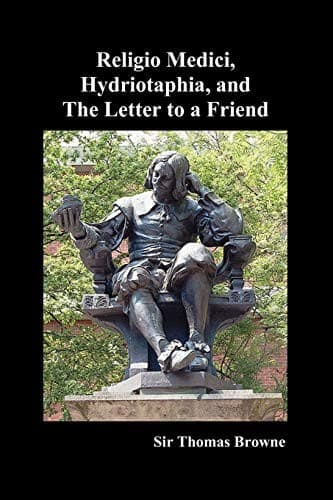
Religio Medici, Hydriotaphia, and the Letter to a FriendBrowne, Thomas, Sir
Religion
Religio Medici, Hydriotaphia, and the Letter to a Friend
Browne, Thomas, Sir
Christian ethics; Christian life; Essays; Funeral rites and ceremonies; Medical ethics; Medicine -- History; Religion and medicine
liberal intentions, and bountiful well wishes. But if the example of
the mite be not only an act of wonder, but an example of the noblest
charity, surely poor men may also build hospitals, and the rich alone
have not erected cathedrals. I have a private method which others
observe not; I take the opportunity of myself to do good; I borrow
occasion of charity from my own necessities, and supply the wants of
others, when I am in most need myself: for it is an honest stratagem
to take advantage of ourselves, and so to husband the acts of virtue,
that, where they are defective in one circumstance, they may repay
their want, and multiply their goodness in another. I have not Peru in
my desires, but a competence and ability to perform those good works
to which he hath inclined my nature. He is rich who hath enough to be
charitable; and it is hard to be so poor that a noble mind may not find
a way to this piece of goodness. “He that giveth to the poor lendeth
to the Lord:” there is more rhetorick in that one sentence than in a
library of sermons. And indeed, if those sentences were understood by
the reader with the same emphasis as they are delivered by the author,
we needed not those volumes of instructions, but might be honest by
an epitome. Upon this motive only I cannot behold a beggar without
relieving his necessities with my purse, or his soul with my prayers.
These scenical and accidental differences between us cannot make me
forget that common and untoucht part of us both: there is under these
centoes[101] and miserable outsides, those mutilate and semi bodies,
a soul of the same alloy with our own, whose genealogy is God’s as
well as ours, and in as fair a way to salvation as ourselves. Statists
that labour to contrive a commonwealth without our poverty take away
the object of charity; not understanding only the commonwealth of a
Christian, but forgetting the prophecy of Christ.[S]
[S] “The poor ye have always with you.”
Public-domain text, read in full here on John Shaqi.
Reviews
Reviews
No reviews yet
Be the first to share your thoughts on this work.
Elsewhere in the archive
Join the Discussion
Join the discussion
Sign in to leave a comment or review.
Sign InorCreate an account