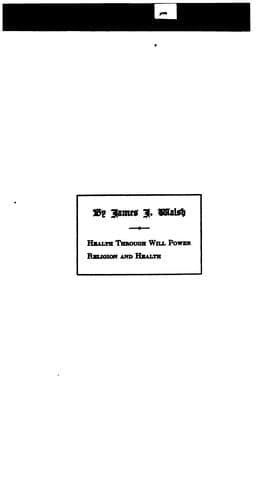
Doctor Norman Porritt, in his book on "Religion and Health", does not
hesitate to say that religion is the only factor that can be helpful
in this extremely important matter of the prophylaxis of sex disease.
He goes so far as to say that "Give to the tempted the reinforcement
of religion, and you place him in a position well-nigh impregnable."
It has been well said that if the man who first wrote "honesty is the
best policy" meant that people should be honest because that was sure
to rebound to their own benefit in the end, he was a rascal at heart.
In something the same way Doctor Porritt suggests that to teach that
purity is the best policy is to take an extremely low motive for the
purpose of combating one of the most alluring temptations that man
has. He says very emphatically and yet surely with a great deal of
common sense: "And what is to be the remedy for the scourge which is
incapacitating and crippling a fifth part of the nation's manhood,
checking the natural expansion of population and sweeping unknown
thousands to untimely graves? There are many remedies. We may look to
the creation of a public sentiment which shall regard immorality as a
disgraceful thing, to be {195} ashamed of rather than proud of; we may
learn to point the finger of scorn at the tempter as readily as we
spurn his victim; we may prove, both by precept and our own example,
that chastity is compatible with health, and that impurity--even when
no gross disease follows--tends to deterioration and disorder; that
the reasoning which gives a sanatory sanction to immorality and vice
is a subtle sophistry. We may cultivate the manly exercises and stamp
out impurity by wholesome books, elevating amusements, and noble
ambitions; we may endeavour to check the spread of these diseases by
legislative restrictions; we may inculcate teetotalism and banish
enervating habits and too stimulating foods. Each of these measures
may do something. Some of them may do much. But all of them have one
fatal defect. They are all tarred with the brush of expediency.
Expediency, and not wrong-doing, is the danger signal they show. And
when the hot blood surges through young veins in the struggle with an
imminent temptation, what becomes of expediency?"
Public-domain text, read in full here on John Shaqi.
Reviews
Reviews
No reviews yet
Be the first to share your thoughts on this work.
Elsewhere in the archive
Join the Discussion
Join the discussion
Sign in to leave a comment or review.
Sign InorCreate an account