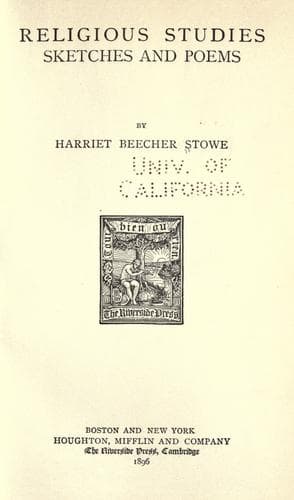
Religious Studies, Sketches and PoemsStowe, Harriet Beecher
Religion
Religious Studies, Sketches and Poems
Stowe, Harriet Beecher
Religion
Here Mary, with the abandon which marks her earnest and poetic
nature, breaks a costly vase of balm and sheds the perfume on the
head of her Lord. It was an action in which she offered up her
whole self--her heart and her life--to be spent for him, like that
fleeting perfume. Judas expostulates, "To what purpose is this
waste?" There is an answering flash from Jesus, like lightning from
a summer cloud. The value that our Lord sets upon love is nowhere
more energetically expressed. This trembling, sensitive heart has
offered itself up wholly to him, and he accepts and defends it.
There is a touch of human pathos in the words, "She is anointing me
for my burial." Her gift had all the sacredness in his eyes of a
death-bed act of tenderness, and he declares, "Wheresoever through
the world this gospel shall be preached, there also shall what this
woman hath done be told for a memorial of her."
Judas slinks back, sullen and silent. The gulf between him and his
Master grows hourly more palpable--as the nature that cannot love
and the nature to whom love is all come in close collision. Judas
and Christ cannot blend any more than oil and water, and the nearer
approach only makes the conflict of nature more evident.
On Monday morning, the day that we now celebrate as Palm Sunday,
Jesus enters Jerusalem. We are told that the great city, now full
of Jews come up from all parts of the world, was moved about him.
We have in the Book of Acts an enumeration of the varieties in
the throng that filled Jerusalem at this time: "Parthians, Medes,
Elamites, dwellers in Mesopotamia and in Judæa and Cappadocia, in
Pontus and Asia, Phrygia and Pamphylia, in Egypt and in the parts
of Libya about Cyrene, and strangers of Rome, Jews and Proselytes,
Cretes and Arabians." When all these strangers heard the shouting,
it is said the "whole city was moved, saying, Who is this? And the
multitude said, This is Jesus, the Prophet of Nazareth in Galilee."
And what was He thinking of, as he came thus for the last time to
the chosen city? We are told "And when he drew near and beheld the
city, he wept over it, saying, If thou hadst known, even thou in
this thy day, the things that belong to thy peace! but now they
are hid from thine eyes." Then follows the prophetic vision of the
destruction of Jerusalem--scenes of horror and despair for which his
gentle spirit bled inwardly.
Public-domain text, read in full here on John Shaqi.
Reviews
Reviews
No reviews yet
Be the first to share your thoughts on this work.
Elsewhere in the archive
Join the Discussion
Join the discussion
Sign in to leave a comment or review.
Sign InorCreate an account