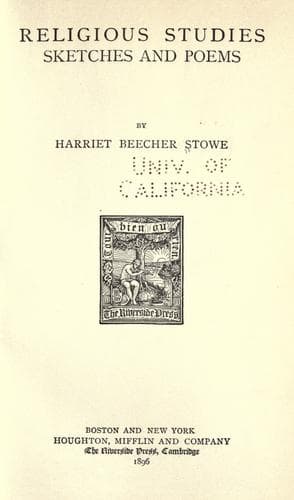
Religious Studies, Sketches and PoemsStowe, Harriet Beecher
Religion
Religious Studies, Sketches and Poems
Stowe, Harriet Beecher
Religion
Now, in the Jewish Sanhedrim Christ had friends and followers.
We are told of Joseph of Arimathea, who would not consent to the
deeds of the council. We are told of Nicodemus, who before now had
spoken boldly in the council, demanding justice and a fair hearing
for Jesus. We may well believe that so extreme a course as was now
proposed met at first strong opposition. There seems to have been
some warm discussion. We may imagine what it was: that Jesus was a
just and noble man, a prophet, a man all of whose deeds and words
had been pure and beneficent, was doubtless earnestly urged. The
advocates, it is true, were not men who had left all to follow
him, or enrolled themselves openly as his disciples, but yet they
could not consent to so monstrous an injustice as this. That the
discussion produced strong feeling is evident from the excited
manner in which Caiaphas sums up: "Ye know nothing at all, nor
consider that it is better that one man should die than that the
whole nation should perish." That was the case as he viewed it,
and he talked precisely as men in our days have often talked when
consenting to an injustice or oppression: Say what you will of this
Jesus; I will not dispute you. Admit, if you please, his virtues and
good works; still, he is a wrong-headed man, that will be the ruin
of our nation. Either he must perish or the nation be destroyed.
And so, on the altar of patriotism this murder was laid as a
sacrifice. And it was this same burning, impatient national spirit
of independence that slew Christ which afterwards provoked the Roman
government beyond endurance, and brought upon Jerusalem wrath to the
uttermost.
The very children and grandchildren of Caiaphas died in untold
miseries in that day of wrath and doom. The decision to reject
Christ was the decision which destroyed Jerusalem with a destruction
more awful than any other recorded in history.
We are apt to consider the actors in this great tragedy as sinners
above all others. But every day and every hour in our times just
such deeds are being reënacted.
Public-domain text, read in full here on John Shaqi.
Reviews
Reviews
No reviews yet
Be the first to share your thoughts on this work.
Elsewhere in the archive
Join the Discussion
Join the discussion
Sign in to leave a comment or review.
Sign InorCreate an account