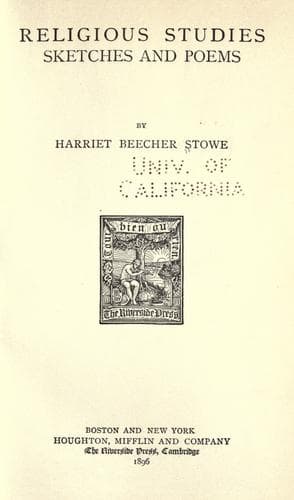
Religious Studies, Sketches and PoemsStowe, Harriet Beecher
Religion
Religious Studies, Sketches and Poems
Stowe, Harriet Beecher
Religion
It is true there is much loose talk about an overruling Providence;
and yet, if fairly stated, the belief of a great many Christians
might be thus expressed: God has organized and set in operation
certain general laws of matter and mind, which work out the
particular results of life, and over these laws he exercises a
general supervision and care, so that all the great affairs of the
world are carried on after the counsel of his own will; and in a
certain general sense, all things are working together for good
to those that love God. But when some simple-minded, childlike
Christian really proceeds to refer all the smaller events of life to
God's immediate care and agency, there is a smile of incredulity,
and it is thought that the good brother displays more Christian
feeling than sound philosophy.
But as life for every individual is made up of fractions and minute
atoms--as those things which go to affect habits and character
are small and hourly recurring, it comes to pass that a belief in
Providence so very wide and general is altogether inefficient for
consecrating and rendering sacred the great body of what comes
in contact with the mind in the experience of life. Only once in
years does the Christian with this kind of belief hear the voice
of the Lord God speaking to him. When the hand of death is laid
on his child, or the bolt strikes down the brother by his side,
then, indeed, he feels that God is drawing near; he listens humbly
for the inward voice that shall explain the meaning and need of
this discipline. When by some unforeseen occurrence the whole of
his earthly property is swept away,--he becomes a poor man,--this
event, in his eyes, assumes sufficient magnitude to have come from
God, and to have a design and meaning; but when smaller comforts are
removed, smaller losses are encountered, and the petty every-day
vexations and annoyances of life press about him, he recognizes no
God, and hears no voice, and sees no design. Hence John Newton says,
"Many Christians, who bear the loss of a child, or the destruction
of all their property, with the most heroic Christian fortitude, are
entirely vanquished and overcome by the breaking of a dish, or the
blunders of a servant, and show so unchristian a spirit, that we
cannot but wonder at them."
So when the breath of slander, or the pressure of human injustice,
comes so heavily on a man as really to threaten loss of character,
and destruction of his temporal interests, he seems forced to
recognize the hand and voice of God, through the veil of human
agencies, and in time-honored words to say:--
"When men of spite against me join,
They are the sword; the hand is thine."
Public-domain text, read in full here on John Shaqi.
Reviews
Reviews
No reviews yet
Be the first to share your thoughts on this work.
Elsewhere in the archive
Join the Discussion
Join the discussion
Sign in to leave a comment or review.
Sign InorCreate an account