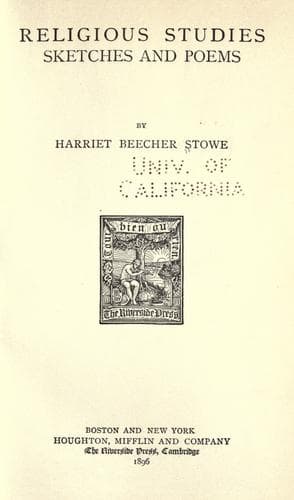
Religious Studies, Sketches and PoemsStowe, Harriet Beecher
Religion
Religious Studies, Sketches and Poems
Stowe, Harriet Beecher
Religion
One of the deepest and most imperative cravings of the human
heart, as it follows its beloved ones beyond the veil, is for
some assurance that they still love and care for us. Could we
firmly believe this, bereavement would lose half its bitterness.
As a German writer beautifully expresses it, "Our friend is not
wholly gone from us; we see across the river of death, in the
blue distance, the smoke of his cottage;" hence the heart, always
creating what it desires, has ever made the guardianship and
ministration of departed spirits a favorite theme of poetic fiction.
But is it, then, fiction? Does revelation, which gives so many hopes
which nature had not, give none here? Is there no sober certainty
to correspond to the inborn and passionate craving of the soul? Do
departed spirits in verity retain any knowledge of what transpires
in this world, and take any part in its scenes? All that revelation
says of a spiritual state is more intimation than assertion; it has
no distinct treatise, and teaches nothing apparently of set purpose;
but gives vague, glorious images, while now and then some accidental
ray of intelligence looks out,--
"like eyes of cherubs shining
From out the veil that hid the ark."
But out of all the different hints and assertions of the Bible we
think a better inferential argument might be constructed to prove
the ministration of departed spirits than for many a doctrine which
has passed in its day for the height of orthodoxy.
First, then, the Bible distinctly says that there is a class of
invisible spirits who minister to the children of men: "Are they
not all ministering spirits, sent forth to minister to those who
shall be heirs of salvation?" It is said of little children, that
"their angels do always behold the face of our Father which is in
heaven." This last passage, from the words of our Saviour, taken
in connection with the well-known tradition of his time, fully
recognizes the idea of individual guardian spirits; for God's
government over mind is, it seems, throughout, one of intermediate
agencies, and these not chosen at random, but with the nicest
reference to their adaptation to the purpose intended. Not even the
All-seeing, All-knowing One was deemed perfectly adapted to become
a human Saviour without a human experience. Knowledge intuitive,
gained from above, of human wants and woes was not enough--to it
must be added the home-born certainty of consciousness and memory;
the Head of all mediation must become human. Is it likely, then,
that, in selecting subordinate agencies, this so necessary a
requisite of a human life and experience is overlooked? While around
the throne of God stand spirits, now sainted and glorified, yet
thrillingly conscious of a past experience of sin and sorrow, and
trembling in sympathy with temptations and struggles like their own,
is it likely that he would pass by these souls, thus burning for the
work, and commit it to those bright abstract beings whose knowledge
Public-domain text, read in full here on John Shaqi.
Reviews
Reviews
No reviews yet
Be the first to share your thoughts on this work.
Elsewhere in the archive
Join the Discussion
Join the discussion
Sign in to leave a comment or review.
Sign InorCreate an account