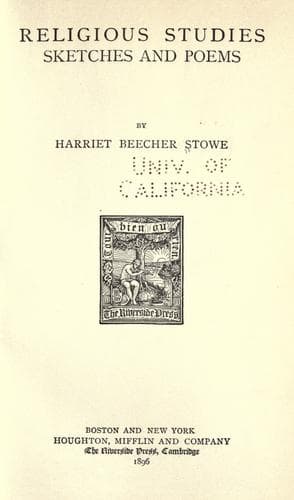
Religious Studies, Sketches and PoemsStowe, Harriet Beecher
Religion
Religious Studies, Sketches and Poems
Stowe, Harriet Beecher
Religion
In time, though the family we speak of never broke off from the
Christian Church, yet if you had been in it, you might have heard
much warm and earnest conversation about things that took place
at the baths, or in feasts to various divinities; but if any one
spoke of Jesus, there was immediately a cold silence, a decorous,
chilling, respectful pause, after which the conversation, with a
bound, flew back into the old channel again.
* * * * *
It was now night; and the house of Onesiphorus the Elder was
blazing with torches, alive with music, and all the hurry and stir
of a sumptuous banquet. All the wealth and fashion of Laodicea
were there, Christian and heathen; and all that the classic
voluptuousness of Oriental Greece could give to shed enchantment
over the scene was there. In ancient times the festivals of
Christians in Laodicea had been regulated in the spirit of the
command of Jesus, as recorded by Luke, whose classical Greek had
made his the established version in Asia Minor. "And thou, when thou
makest a feast, call not thy friends and thy kinsmen, nor thy rich
neighbors, lest they also bid thee, and a recompense be made thee.
But when thou makest a feast, call the poor, and the maimed, and
the lame, and the blind, and thou shalt be blessed; for they cannot
recompense thee, but thou shalt be recompensed at the resurrection
of the just."
That very day, before the entertainment, had this passage been
quoted in the ears of the family by Cleon, the youngest son, who,
different from all his family, had cherished in his bosom the
simplicity of the old belief.
"How ridiculous! how absurd!" had been the reply of the more
thoughtless members of the family, when Cleon cited the above
passage as in point to the evening's entertainment. The dark-eyed
mother looked reproof on the levity of the younger children, and
decorously applauded the passage, which she said had no application
to the matter in hand.
"But, mother, even if the passage be not literally taken, it
must mean something. What did the Lord Jesus intend by it? If we
Christians may make entertainments with all the parade and expense
of our heathen neighbors, and thus spend the money that might be
devoted to charity, what does this passage mean?"
"Your father gives in charity as handsomely as any Christian in
Laodicea," said his mother warmly.
"Nay, mother, that may be; but I bethink me now of two or three
times when means have been wanting for the relieving of the poor,
and the ransoming of captives, and the support of apostles, when we
have said that we could give no more."
"My son," said his mother, "you do not understand the ways of the
world."
"Nay, how should he," said Thalia, "shut up day and night with that
old papyrus of St. Luke and Paul's Epistles? One may have too much
of a good thing."
"But does not the holy Paul say, 'Be not conformed to this world'?"
Public-domain text, read in full here on John Shaqi.
Reviews
Reviews
No reviews yet
Be the first to share your thoughts on this work.
Elsewhere in the archive
Join the Discussion
Join the discussion
Sign in to leave a comment or review.
Sign InorCreate an account