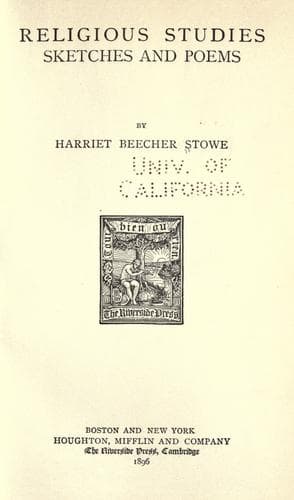
Religious Studies, Sketches and PoemsStowe, Harriet Beecher
Religion
Religious Studies, Sketches and Poems
Stowe, Harriet Beecher
Religion
"one Jesus which was dead, and whom Paul affirmed to be alive," is
nominally, at least, the object of religious homage in all the more
cultivated portions of the globe; and to hearts scattered through
all regions of the earth this same Jesus is now a sacred and living
name, dearer than all household sounds, all ties of blood, all
sweetest and nearest affections of humanity. "I am ready not only to
be bound, but also to die for the name of the Lord Jesus," are words
that have found an echo in the bosoms of thousands in every age
since then; that would, if need were, find no less echo in thousands
now. Considering Christ as a man, and his death as a mere pathetic
story,--considering him as one of the great martyrs for truth, who
sealed it with his blood,--this result is wholly unaccountable.
Other martyrs have died, bravely and tenderly, in their last
hours "bearing witness of the godlike" that is in man; but who so
remembers them? Who so loves them? To whom is any one of them a
living presence, a life, and all? Yet so thousands look on Jesus at
this hour.
Nay, it is because this story strikes home to every human bosom
as an individual concern. A thrilling voice speaks from this scene
of anguish to every human bosom: This is thy Saviour. Thy sin hath
done this. It is the appropriative words, thine and mine, which make
this history different from any other history. This was for _me_,
is the thought which has pierced the apathy of the Greenlander, and
kindled the stolid clay of the Hottentot; and no human bosom has
ever been found so low, so lost, so guilty, so despairing, that
this truth, once received, has not had power to redeem, regenerate,
and disenthrall. Christ so presented becomes to every human being a
friend nearer than the mother who bore him; and the more degraded,
the more hopeless and polluted is the nature, the stronger comes on
the living reaction, if this belief is really and vividly enkindled
with it. But take away this appropriative, individual element, and
this legend of Jesus' death has no more power than any other. He is
to us no more than Washington, or Socrates, or Howard. And where is
there not a touchstone to try every theory of atonement? Whatever
makes a man feel that he is only a spectator, an uninterested
judge in this matter, is surely astray from the idea of the Bible.
Whatever makes him feel that his sins have done this deed, that he
is bound, soul and body, to this Deliverer, though it may be in many
points philosophically erroneous, cannot go far astray.
Public-domain text, read in full here on John Shaqi.
Reviews
Reviews
No reviews yet
Be the first to share your thoughts on this work.
Elsewhere in the archive
Join the Discussion
Join the discussion
Sign in to leave a comment or review.
Sign InorCreate an account