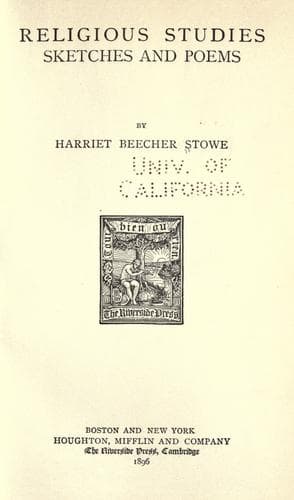
Religious Studies, Sketches and PoemsStowe, Harriet Beecher
Religion
Religious Studies, Sketches and Poems
Stowe, Harriet Beecher
Religion
"It seems to me," said Miss B., "that this view of the subject will
reduce us to silence almost as much as the other. How is one ever to
estimate the consequences of their words?--people are affected in so
many different ways by the same thing."
"I suppose," said her uncle, "we are only responsible for such
results as by carefulness and reflection we might have foreseen.
It is not for ill-judged words, but for idle words, that we are
to be judged--words uttered without any consideration at all, and
producing bad results. If a person really anxious to do right
misjudges as to the probable effect of what he is about to say on
others, it is quite another thing."
"But, uncle, will not such carefulness destroy all freedom in
conversation?" said Helen.
"If you are talking with a beloved friend, Helen, do you not use an
instinctive care to avoid all that might pain that friend?"
"Certainly."
"And do you find this effort a restraint on your enjoyment?"
"Certainly not."
"And you, from your own feelings, avoid what is indelicate and
impure in conversation, and yet feel it no restraint?"
"Certainly."
"Well, I suppose the object of Christian effort should be so to
realize the character of our Saviour, and conform our tastes and
sympathies to his, that we shall instinctively avoid all in our
conversation that would be displeasing to him. A person habitually
indulging jealous, angry, or revengeful feeling, a person habitually
worldly in his spirit, a person allowing himself in skeptical and
unsettled habits of thought, _cannot_ talk without doing harm. This
is our Saviour's account of the matter in the verses immediately
before the passage we were speaking of--'How _can_ ye, being
evil, speak good things? for out of the abundance of the heart
the mouth speaketh. A good man out of the good treasure of his
heart bringeth forth good things, and an evil man out of the evil
treasure of his heart bringeth forth evil things.' The highest flow
of animal spirits would never hurry a pure-minded person to say
anything indelicate or gross; and in the same manner, if a person
is habitually Christian in all his habits of thought and feeling,
he will be able without irksome watchfulness to avoid what may be
injurious even in the most unrestrained conversation."
HOW DO WE KNOW
It was a splendid room. Rich curtains swept down to the floor in
graceful folds, half excluding the light, and shedding it in soft
hues over the fine old paintings on the walls, and over the broad
mirrors that reflect all that taste can accomplish by the hand of
wealth. Books, the rarest and most costly, were around, in every
form of gorgeous binding and gilding, and among them, glittering
in ornament, lay a magnificent Bible--a Bible too beautiful in its
appointments, too showy, too ornamental, ever to have been meant to
be read--a Bible which every visitor should take up and exclaim,
"What a beautiful edition! what superb bindings!" and then lay it
down again.
Public-domain text, read in full here on John Shaqi.
Reviews
Reviews
No reviews yet
Be the first to share your thoughts on this work.
Elsewhere in the archive
Join the Discussion
Join the discussion
Sign in to leave a comment or review.
Sign InorCreate an account