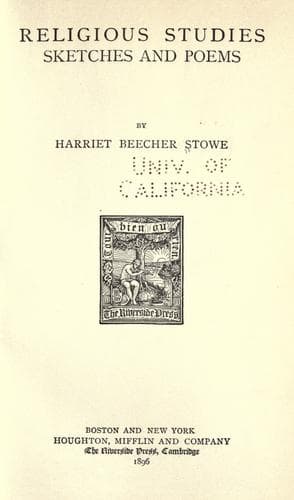
Religious Studies, Sketches and PoemsStowe, Harriet Beecher
Religion
Religious Studies, Sketches and Poems
Stowe, Harriet Beecher
Religion
So great was his monomania for benevolence that it could not at
all confine itself to the streets of Boston, the circle of his
relatives, or even the United States of America. Mr. H. was fully
posted up in the affairs of India, Burmah, China, and all those
odd, out-of-the-way places, which no sensible man ever thinks of
with any interest, unless he can make some money there; and money,
it is to be confessed, Mr. H. didn't make there, though he spent an
abundance. For getting up printing-presses in Ceylon for Chinese
type, for boxes of clothing and what-not to be sent to the Sandwich
Islands, for schoolbooks for the Greeks, and all other nonsense of
that sort, Mr. H. was without a parallel. No wonder his rich brother
merchants sometimes thought him something of a bore, since, his
heart being full of all these matters, he was rather apt to talk
about them, and sometimes to endeavor to draw them into fellowship,
to an extent that was not to be thought of.
So it came to pass often, that though Mr. H. was a thriving
business man, with some ten thousand a year, he often wore a pretty
threadbare coat, the seams whereof would be trimmed with lines of
white; and he would sometimes need several pretty plain hints on the
subject of a new hat before he would think he could afford one.
Now, it is to be confessed the world is not always grateful to those
who thus devote themselves to its interests; and Mr. H. had as much
occasion to know this as any other man. People got so used to his
giving, that his bounty became as common and as necessary as that of
a higher Benefactor, "who maketh his sun to rise upon the evil and
the good, and sendeth rain upon the just and the unjust;" and so it
came to pass that people took them, as they do the sunshine and the
rain, quite as matters of course, not thinking much about them when
they came, but particularly apt to scold when they did not come.
But Mr. H. never cared for that. He did not give for gratitude;
he did not give for thanks, nor to have his name published in the
papers as one of six who had given fifty thousand to do so and so;
but he gave because it was in him to give, and we all know that it
is an old rule in medicine, as well as morals, that what is in a
man must be brought out. Then, again, he had heard it reported that
there had been One of distinguished authority who had expressed the
opinion that it was "more blessed to give than to receive," and he
very much believed it--believed it because the One who said it must
have known, since for man's sake he once gave away _all_.
Public-domain text, read in full here on John Shaqi.
Reviews
Reviews
No reviews yet
Be the first to share your thoughts on this work.
Elsewhere in the archive
Join the Discussion
Join the discussion
Sign in to leave a comment or review.
Sign InorCreate an account