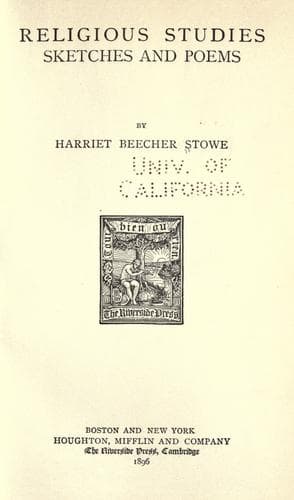
Religious Studies, Sketches and PoemsStowe, Harriet Beecher
Religion
Religious Studies, Sketches and Poems
Stowe, Harriet Beecher
Religion
The little quiet village of Camden stands under the brow of a
rugged hill in one of the most picturesque parts of New England;
and its regular, honest, and industrious villagers were not a
little surprised and pleased that Mr. James, a rich man, and
pleasant-spoken withal, had concluded to take up his residence among
them. He brought with him a pretty, genteel wife, and a group of
rosy, romping, but amiable children; and there was so much of good
nature and kindness about the manners of every member of the family,
that the whole neighborhood were prepossessed in their favor. Mr.
James was a man of somewhat visionary and theoretical turn of
mind, and very much in the habit of following out his own ideas of
right and wrong, without troubling himself particularly as to the
appearance his course might make in the eyes of others. He was a
supporter of the ordinances of religion, and always ready to give
both time and money to promote any benevolent object; and though
he had never made any public profession of religion, or connected
himself with any particular set of Christians, still he seemed
to possess great reverence for God, and to worship him in spirit
and in truth, and he professed to make the Bible the guide of his
life. Mr. James had been brought up under a system of injudicious
religious restraint. He had determined, in educating his children,
to adopt an exactly opposite course, and to make religion and all
its institutions sources of enjoyment. His aim, doubtless, was an
appropriate one; but his method of carrying it out, to say the
least, was one which was not a safe model for general imitation.
In regard to the Sabbath, for example, he considered that, although
the plan of going to church twice a day, and keeping all the family
quiet within doors the rest of the time, was good, other methods
would be much better. Accordingly, after the morning service, which
he and his whole family regularly attended, he would spend the rest
of the day with his children. In bad weather he would instruct
them in natural history, show them pictures, and read them various
accounts of the works of God, combining all with such religious
instruction and influence as a devotional mind might furnish. When
the weather permitted, he would range with them through the fields,
collecting minerals and plants, or sail with them on the lake,
meanwhile directing the thoughts of his young listeners upward
to God, by the many beautiful traces of his presence and agency,
which superior knowledge and observation enabled him to discover
and point out. These Sunday strolls were seasons of most delightful
enjoyment to the children. Though it was with some difficulty that
their father could restrain them from loud and noisy demonstrations
of delight, and he saw with some regret that the mere animal
excitement of the stroll seemed to draw the attention too much from
religious considerations, and, in particular, to make the exercises
Public-domain text, read in full here on John Shaqi.
Reviews
Reviews
No reviews yet
Be the first to share your thoughts on this work.
Elsewhere in the archive
Join the Discussion
Join the discussion
Sign in to leave a comment or review.
Sign InorCreate an account