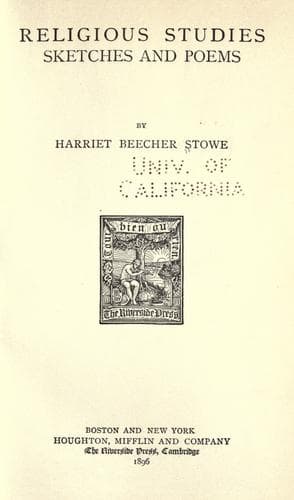
Religious Studies, Sketches and PoemsStowe, Harriet Beecher
Religion
Religious Studies, Sketches and Poems
Stowe, Harriet Beecher
Religion
"Let me quote an answer from the same chapter," said Mr. Richards.
"'Let no man put a stumbling-block, or an occasion to fall, in his
brother's way: let not your good be evil spoken of. It is good
neither to eat flesh nor drink wine, nor anything whereby thy
brother stumbleth, or is offended, or made weak.' Now, my good
friend, you happen to be endowed with a certain tone of mind which
enables you to carry through your mode of keeping the Sabbath with
little comparative evil, and much good, so far as your family
is concerned; but how many persons in this neighborhood, do you
suppose, would succeed equally well if they were to attempt it? If
it were the common custom for families to absent themselves from
public worship in the afternoon, and to stroll about the fields,
or ride, or sail, how many parents, do you suppose, would have the
dexterity and talent to check all that was inconsistent with the
duties of the day? Is it not your ready command of language, your
uncommon tact in simplifying and illustrating, your knowledge of
natural history and of Biblical literature, that enable you to
accomplish the results that you do? And is there one parent in a
hundred that could do the same? Now, just imagine our neighbor,
'Squire Hart, with his ten boys and girls, turned out into the
fields on a Sunday afternoon to profit withal: you know he can
never finish a sentence without stopping to begin it again half a
dozen times. What progress would he make in instructing them? And
so of a dozen others I could name along this very street here.
Now, you men of cultivated minds must give your countenance to
courses which would be best for society at large, or, as the
sentiment was expressed by St. Paul, 'We that are strong ought to
bear the infirmities of the weak, and not to please ourselves,
for even Christ pleased not himself.' Think, my dear sir, if our
Saviour had gone only on the principle of avoiding what might be
injurious to his own improvement, how unsafe his example might
have proved to less elevated minds. Doubtless he might have made
a Sabbath day fishing excursion an occasion of much elevated and
impressive instruction; but, although he declared himself 'Lord
of the Sabbath day,' and at liberty to suspend its obligation at
his own discretion, yet he never violated the received method of
observing it, except in cases where superstitious tradition trenched
directly on those interests which the Sabbath was given to promote.
He asserted the right to relieve pressing bodily wants, and to
administer to the necessities of others on the Sabbath, but beyond
that he allowed himself in no deviation from established custom."
Mr. James looked thoughtful. "I have not reflected on the subject in
this view," he replied. "But, my dear sir, considering how little of
the public services of the Sabbath is on a level with the capacity
of younger children, it seems to me almost a pity to take them to
church the whole of the day."
Public-domain text, read in full here on John Shaqi.
Reviews
Reviews
No reviews yet
Be the first to share your thoughts on this work.
Elsewhere in the archive
Join the Discussion
Join the discussion
Sign in to leave a comment or review.
Sign InorCreate an account