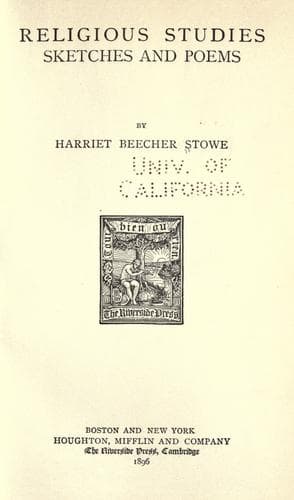
Religious Studies, Sketches and PoemsStowe, Harriet Beecher
Religion
Religious Studies, Sketches and Poems
Stowe, Harriet Beecher
Religion
"And one of the Pharisees desired him that he would eat with
him, and he went into the Pharisee's house and sat down to meat.
And behold a woman in that city which was a sinner, when she
knew that Jesus sat at meat in the Pharisee's house, brought
an alabaster box of ointment, and stood at his feet behind
him, weeping, and began to wash his feet with tears, and did
wipe them with the hairs of her head, and kissed his feet and
anointed them with the ointment. Now when the Pharisee which had
bidden him saw it, he spake within himself, saying, This man, if
he were a prophet, would have known who and what manner of woman
this is, for she is a sinner. And Jesus answering said unto
him, Simon, I have somewhat to say unto thee. He said unto him,
Master, say on. There was a certain creditor had two debtors;
the one owed him five hundred pence and the other fifty, and
when they had nothing to pay he frankly forgave them both. Tell
me, therefore, which will love him most. Simon answered and
said, I suppose he to whom he forgave most. And he said unto
him, Thou hast rightly judged. And he turned to the woman and
said unto Simon, Seest thou this woman? I entered into thy house
and thou gavest me no water for my feet, but she hath washed my
feet with tears and wiped them with the hairs of her head. Thou
gavest me no kiss, but this woman, since the time I came in,
hath not ceased to kiss my feet. My head with oil thou didst not
anoint, but she hath anointed my feet with ointment. Wherefore,
I say unto you, her sins, which are many, are forgiven her, for
she loved much; but to whom little is forgiven the same loveth
little. And he said unto her, Thy sins are forgiven. And they
that sat at meat began to say within themselves, Who is this
that forgiveth sins also? And he said to the woman, Thy faith
hath saved thee; go in peace."
Nothing can be added to the pathos and solemn dignity of this
story, in which our Lord assumed with tranquil majesty the rights
to supreme love possessed by the Creator, and his sovereign power
to forgive sins and dispense favors. The repentant Magdalene became
henceforth one of the characteristic figures in the history of the
Christian Church. Mary Magdalene became eventually a prominent
character in the mythic legends of the mediæval mythology. A long
history of missionary labors and enthusiastic preaching of the
gospel in distant regions of the earth is ascribed to her. Churches
arose that bore her name, hymns were addressed to her. Even the
reforming Savonarola addresses one of his spiritual canticles to St.
Mary Magdalene. The various pictures of her which occur in every
part of Europe are a proof of the interest which these legends
inspired. The most of them are wild and poetic, and exhibit a
striking contrast to the concise brevity and simplicity of the New
Testament story.
Public-domain text, read in full here on John Shaqi.
Reviews
Reviews
No reviews yet
Be the first to share your thoughts on this work.
Join the Discussion
Join the discussion
Sign in to leave a comment or review.
Sign InorCreate an account