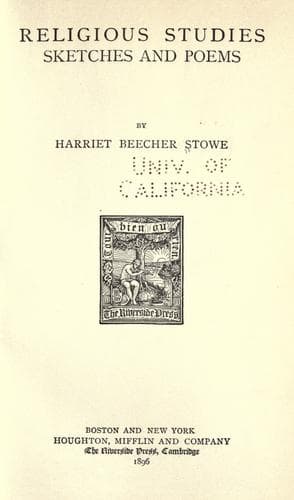
Religious Studies, Sketches and PoemsStowe, Harriet Beecher
Religion
Religious Studies, Sketches and Poems
Stowe, Harriet Beecher
Religion
The mythic legends make up a romance in which Mary the sister of
Martha and Mary Magdalene the sinner are oddly considered as the
same person. It is sufficient to read the chapter in St. John which
gives an account of the raising of Lazarus, to perceive that such a
confusion is absurd. Mary and Martha there appear as belonging to
a family in good standing to which many flocked with expressions
of condolence and respect in time of affliction. And afterwards,
in that grateful feast made for the restoration of their brother,
we read that so many flocked to the house that the jealousy of
the chief priests was excited. All these incidents, representing
a family of respectability, are entirely inconsistent with any
such supposition. But while we repudiate this extravagance of the
tradition, there does seem ground for identifying the Mary Magdalene
who was one of the most devoted followers of our Lord with the
forgiven sinner of this narrative. We read of a company of women who
followed Jesus and ministered to him. In the eighth chapter of Luke
he is said to be accompanied by "certain women which had been healed
of evil spirits and infirmities," among whom is mentioned "Mary
called Magdalene," as having been a victim of demoniacal possession.
Some women of rank and fortune also are mentioned as members of
the same company: "Joanna the wife of Chusa, Herod's steward, and
Susanna, and many others who ministered to him of their substance."
A modern commentator thinks it improbable that Mary Magdalene could
be identified with the "sinner" spoken of by St. Luke, because women
of standing like Joanna and Susanna would not have received one of
her class to their company. We ask why not? If Jesus had received
her, had forgiven and saved her; if _he_ acknowledged previously her
grateful ministrations,--is it likely that they would reject her? It
was the very peculiarity and glory of the new kingdom that it had a
better future for sinners, and for sinful woman as well as sinful
man. Jesus did not hesitate to say to the proud and prejudiced
religious aristocracy of his day, "The publicans and harlots go
into the kingdom of heaven before you." We cannot doubt that
the loving Christian women who ministered to Jesus received this
penitent sister as a soul absolved and purified by the sovereign
word of their Lord, and henceforth there was for her a full scope
for that ardent, self-devoting power of her nature which had been
her ruin, and was now to become her salvation.
Public-domain text, read in full here on John Shaqi.
Reviews
Reviews
No reviews yet
Be the first to share your thoughts on this work.
Join the Discussion
Join the discussion
Sign in to leave a comment or review.
Sign InorCreate an account