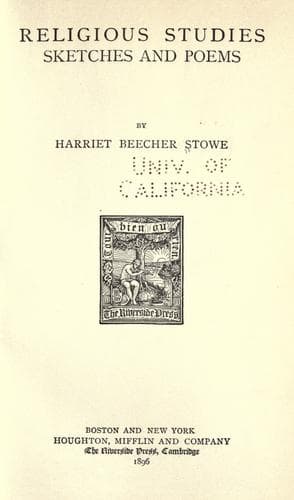
Religious Studies, Sketches and PoemsStowe, Harriet Beecher
Religion
Religious Studies, Sketches and Poems
Stowe, Harriet Beecher
Religion
It appears that in her way Martha was a religious woman, a sincere
member of the Jewish Church, and an intense believer. The preaching
of Christ was the great religious phenomenon of the times, and
Martha, Mary, and Lazarus joined the crowd who witnessed his
miracles and listened to his words. Both women accepted his message
and believed his Messiahship--Martha, from the witness of his
splendid miracles; Mary, from the deep accord of her heart with
the wonderful words he had uttered. To Martha he was the King that
should reign in splendor at Jerusalem, and raise their nation to an
untold height of glory; to Mary he was the answer to the eternal
question--the Way, the Truth, the Life, for which she had been
always longing.
Among many who urge and press hospitality, Martha's invitation
prevails. A proud home is that, when Jesus follows her--her prize,
her captive. The woman in our day who has captured in her net of
hospitalities the orator, the poet, the warrior--the star of all
eyes, the central point of all curiosity, desire, and regard--can
best appreciate Martha's joy. She will make an entertainment
that will do credit to the occasion. She revolves prodigies of
hospitality. She invites guests to whom her Acquisition shall
be duly exhibited, and all is hurry, bustle, and commotion. But
Mary follows him, silent, with a fluttering heart. His teaching
has aroused the divine longing, the immortal pain, to a throbbing
intensity; a sweet presentiment fills her soul, that she is near One
through whom the way into the Holiest is open, and now is the hour.
She neither hears nor sees the bustle of preparation; but apart,
where the Master has seated himself, she sits down at his feet, and
her eyes, more than her voice, address to him that question and that
prayer which are the question and the one great reality of all this
fleeting, mortal life.
The question is answered; the prayer is granted. At his feet she
becomes spiritually clairvoyant. The way to God becomes clear and
open. Her soul springs toward the light; is embraced by the peace of
God that passeth understanding. It is a soul-crisis, and the Master
sees that in that hour his breath has unfolded into blossom buds
that had been struggling in darkness. Mary has received in her bosom
the "white stone with the new name, which no man knoweth save him
that receiveth it," and of which Jesus only is the giver. As Master
and disciple sit in that calm and sweet accord, in which giver and
receiver are alike blessed, suddenly Martha appears and breaks into
the interview, in a characteristically imperative sentence: "Lord,
dost thou not care that my sister hath left me to serve alone? Bid
her, therefore, that she help me."
Public-domain text, read in full here on John Shaqi.
Reviews
Reviews
No reviews yet
Be the first to share your thoughts on this work.
Elsewhere in the archive
Join the Discussion
Join the discussion
Sign in to leave a comment or review.
Sign InorCreate an account