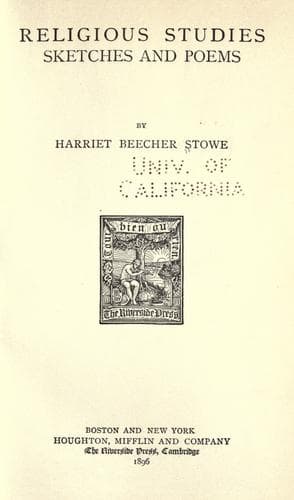
Religious Studies, Sketches and PoemsStowe, Harriet Beecher
Religion
Religious Studies, Sketches and Poems
Stowe, Harriet Beecher
Religion
What was the charm about him, that he whose rule of morality was
stricter than that of Scribes or Pharisees yet attracted and drew
after him the most abandoned classes? They saw that he loved them.
Yes, he really loved them. The infinite love of God looked through
his eyes, breathed in his voice, and shed a persuasive charm through
all his words. To the intellectual and cultured men of the better
classes his word was, "Ye must be born again;" but to these poor
wanderers he said, "Ye may be born again. All is not lost. Purity,
love, a higher life, are all for you,"--and he said it with such
energy, such vital warmth of sympathy, that they believed him.
They crowded round him and he welcomed them; they invited him to
their houses and he went; he sat with them at table; he held their
little ones in his arms; he gave himself to them. When the Scribes
and Pharisees murmured at this intimacy, he answered, "The whole
need not the Physician, but those that are sick; I came not to call
the righteous, but sinners." His most beautiful parables, of the
lost sheep, the lost coin, and the Prodigal Son, were all poured
out of the fullness of his heart for them--and what a heart! What
news indeed, to these lost ones, to be told that their Father cared
for them the more because they were lost; that he went after them
because they wandered; and that all around the pure throne of God
were pitying eyes watching for their return, and strong hands of
welcome stretched out to aid them back. No wonder that the poor lost
woman of the street had such a courage and hope awakened in her that
she pressed through the sneering throng, and under the very eyes of
Scribe and Pharisee found her refuge and rest at the gracious feet
of such a Master. No wonder that Matthew the publican rose up at
once from the receipt of custom and left all to follow that Jesus,
who had taught him that he too might be a son of God.
And we read of one Zaccheus, a poor worldly little man, who had
lived a hard, sharp, extortionate life, and perhaps was supposed to
have nothing good in him; but even he felt a singular internal stir
and longing for something higher, awakened by this preacher, and
when he heard that Jesus of Nazareth was passing he ran and climbed
a tree that he might look on him as he passed. But the gracious
Stranger paused under the tree, and a sweet, cheerful voice said,
"Zaccheus, make haste and come down, for to-day I must dine at thy
house." Trembling, scarce able to believe his good fortune, we are
told he came down and received Jesus joyfully. Immediately, as
flowers burst out under spring sunshine, awoke the virtues in that
heart: "Lord, half my goods I give to the poor, and if I have taken
anything by false accusation I restore fourfold." This shows that
the influence of Jesus was no mere sentimental attraction, but a
vital, spiritual force, corresponding to what was said of him: "As
many as received him to them gave he power to become sons of God."
Public-domain text, read in full here on John Shaqi.
Reviews
Reviews
No reviews yet
Be the first to share your thoughts on this work.
Elsewhere in the archive
Join the Discussion
Join the discussion
Sign in to leave a comment or review.
Sign InorCreate an account