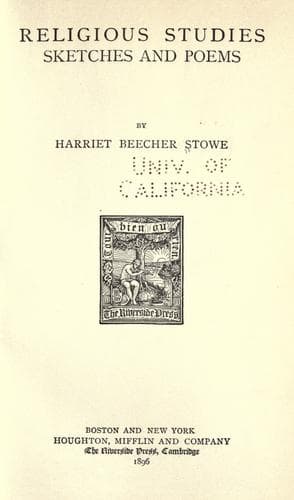
Religious Studies, Sketches and PoemsStowe, Harriet Beecher
Religion
Religious Studies, Sketches and Poems
Stowe, Harriet Beecher
Religion
Yes, it is. This is the peculiarity of the Christian religion--the
special gift of Christ to every soul that will receive it from
him. In his hour of deepest anguish, when every earthly resort was
failing him, when he was about to be deserted, denied, betrayed,
tortured even unto death, he had this great gift of peace, and he
left it as a legacy to his followers:--
"Peace I leave with you; my peace I give unto you. Not as the
world giveth give I unto you."
He says himself that his peace is not what the world giveth. It does
not come from anything in this life; it cannot be taken away by
anything in this life; it is wholly divine. As a white dove looks
brighter and fairer against a black thunder-cloud, so Christ's peace
is brightest and sweetest in darkness and adversity.
Is not this rest of the soul, this perfect peace, worth having? Do
the majority of Christians have it? Would it not lengthen the days
and strengthen the health of many a man and woman if they could
attain it? But how shall we get this gift? That is an open secret.
St. Paul told it to the Philippians in one simple direction:--
"Be not anxious about anything, but in everything, by prayer and
supplication, with thanksgiving, let your requests be made known
unto God; and the peace of God that passeth understanding shall
keep your heart and mind."
There we have it.
Now if we look back to the history of these Philippians, as told in
the Book of Acts, we shall see that when Paul exhorted them never
to be anxious about anything, but always with thanksgiving to let
their wants be known to God, he preached exactly what they had seen
him practice among them. For this Philippian church was at first a
little handful of people gathered to Jesus by hearing Paul talk in
a prayer-meeting held one Sunday morning by the riverside. There
Lydia, the seller of fine linen from Thyatira, first believed with
her house, and a little band of Christians was gathered. But lo! in
the very commencement of the good work a tumult was raised, and Paul
and Silas were swooped down upon by the jealous Roman authorities,
ignominiously and cruelly scourged, and then carried to prison and
shut up with their feet fast in the stocks. Here was an opportunity
to test their serenity. Did their talisman work, or did it fail?
What did the Apostles do? We are told: "At midnight Paul and Silas
prayed and sang praises to God, and the prisoners heard them." That
prayer went up with a shout of victory--it was as Paul directs,
prayer and supplication with thanksgiving. Then came the opening of
prison doors, the loosing of bonds, and the jailer fell trembling
at the feet of his captives, saying, "Sirs, what must I do to be
saved?" And that night the jailer and all his house were added to
the church at Philippi. So, about eleven years after, when Paul's
letter came back from Rome to the Philippian church and was read out
in their prayer-meeting, we can believe that the old Roman jailer,
Public-domain text, read in full here on John Shaqi.
Reviews
Reviews
No reviews yet
Be the first to share your thoughts on this work.
Elsewhere in the archive
Join the Discussion
Join the discussion
Sign in to leave a comment or review.
Sign InorCreate an account