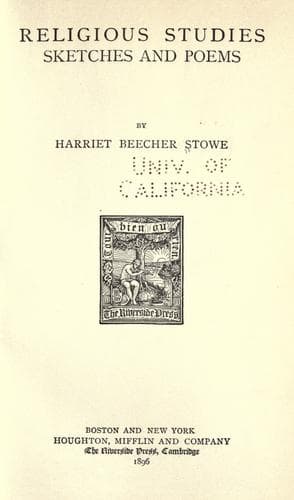
Religious Studies, Sketches and PoemsStowe, Harriet Beecher
Religion
Religious Studies, Sketches and Poems
Stowe, Harriet Beecher
Religion
"Oh, what joy we often forfeit!
Oh, what needless pain we bear!
All because we do not carry
Everything to God in prayer."
XX
THE CHURCH OF THE MASTER
What is the true idea of a Christian church, and what the temper and
spirit in which its affairs should be conducted?
For this inquiry certainly we are not to go back to New England
or Cotton Mather primarily, nor yet to the earlier Anglican
authorities, or the long line of Roman precedent, and the Fathers of
the Church, nor even to the Apostolic churches, but to Jesus Christ
himself, and to the earliest association that could be called a
Christian church.
There is a difference in this discussion between _the_ Church and
_a_ church. _The_ Church is the great generic unity or outside
organization; _a_ church is a society related to the whole, as a
private family to the State.
In the time of our Lord the generic body--_the_ Church of God--was
the Jewish church. Jesus was a regularly initiated member of that
church, and very careful never to depart from any of its forms or
requirements. He announced in the Sermon on the Mount that, in
regard to the Jewish law, he was not come to destroy but to fulfill.
He said distinctly to his disciples: "The Scribes and Pharisees
sit in Moses' seat: all things therefore whatsoever they bid you
observe, that observe and do; but do ye not after their works, for
they say and do not." The Apostles never separated formally from
the Jewish church. They were so careful in this regard that they on
one occasion induced St. Paul, who was reported to be a schismatic,
to go in a very marked and public manner into the Jewish temple
and conform to the Jewish ritual; and when he addressed a company
of Jews on one occasion he commenced with the words: "Men and
brethren, I am a Pharisee and the son of a Pharisee." He elsewhere
speaks of the perfectness of this initiation into all the customs
and privileges of the national church--that he was a Hebrew of the
Hebrews.
The Christian Church arose inside the Jewish church, exactly as the
Methodists arose inside the Church of England. They were a society
professing subjection and obedience to the national church in all
respects where the higher law of God did not require them to go
against earthly ordinances. Thus, when the Jewish Sanhedrin forbade
the Apostles to preach in the name of Jesus, they answered, "Whether
it be right in the sight of God to hearken unto you more than unto
God, judge ye." In like spirit did John Wesley and his ministers
answer the bishops when they tried to shut their mouths from
preaching the gospel to the poor of England.
Public-domain text, read in full here on John Shaqi.
Reviews
Reviews
No reviews yet
Be the first to share your thoughts on this work.
Elsewhere in the archive
Join the Discussion
Join the discussion
Sign in to leave a comment or review.
Sign InorCreate an account