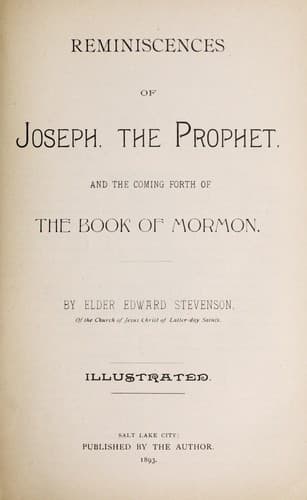
Reminiscences of Joseph, the Prophet, and the Coming Forth of the Book of MormonStevenson, Edward
Religion
Reminiscences of Joseph, the Prophet, and the Coming Forth of the Book of Mormon
Stevenson, Edward
Book of Mormon; Latter Day Saint churches; Smith, Joseph, Jr., 1805-1844
When I heard the three witnesses testify to the coming forth of the
Book of Mormon, and that they had in open daylight both seen and
heard the voice of the angel, I knew their testimony was true. My
first impression of Joseph nearly sixty years ago was that he was a
true prophet, and I formed a love for him which increased with our
acquaintance. I was with him in the state of Missouri during those
trying scenes until his imprisonment in Liberty jail, and subsequently
in Illinois, and with the bereaved family and thousands of Latter-day
Saints shed a tear over his remains as he lay silently in death's
embrace. I took a last look at him in the Nauvoo Mansion in June, 1844.
Joseph Bates Nobles stated to me that he was with the Prophet when he
was going voluntarily to give himself up to the pretended requirements
of the law, on which occasion he said:
"I am going like a lamb to the slaughter, but I am calm as a summer's
morning; I have a conscience void of offence towards God and towards
all men. I shall die innocent, and it shall yet be said of me--'He was
murdered in cold blood.'"
Hyrum also knew of their doom, for on the morning just before leaving
for the murderous prison he turned down the leaf of the fifth chapter
of the Book of Ether, which reads as follows:
"And it came to pass that I prayed unto the Lord that he would give
unto the gentiles grace, that they might have charity. And it came to
pass that the Lord said unto me, if they have not charity, it mattereth
not unto you, thou hast been faithful; wherefore, thy garments are
clean. And because thou hast seen thy weakness, thou shalt be made
strong, even to the sitting down in the place which I have prepared
in the mansions of my father. And now I----bid farewell unto the
gentiles; yea, and also until my brethren whom, I love, [and all who
knew him well knew of his mercy and benevolence], until we shall meet
before the judgment seat of Christ, where all men shall know that my
garments are not spotted with your blood."
They were innocent of crime, as had been proven many, many times.
It was a conspiracy of "traitors and wicked men," and their blood,
as I saw it on the floor of Carthage jail in 1844, soon after their
martyrdom, and again in 1888, is still there as a witness against the
murderers.
Public-domain text, read in full here on John Shaqi.
Reviews
Reviews
No reviews yet
Be the first to share your thoughts on this work.
Join the Discussion
Join the discussion
Sign in to leave a comment or review.
Sign InorCreate an account