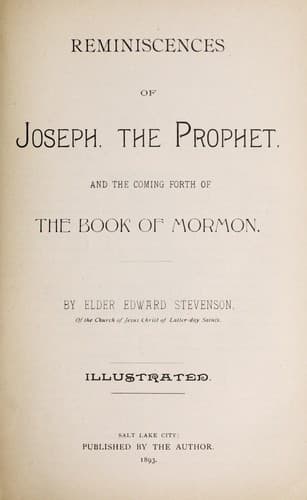
Reminiscences of Joseph, the Prophet, and the Coming Forth of the Book of MormonStevenson, Edward
Religion
Reminiscences of Joseph, the Prophet, and the Coming Forth of the Book of Mormon
Stevenson, Edward
Book of Mormon; Latter Day Saint churches; Smith, Joseph, Jr., 1805-1844
The jail is now transformed into a comfortable private residence, and
is occupied by Mrs. Elizabeth Mathews Browning, her husband having
deeded it to her. Many years ago the county sold the premises to Mr.
B. F. Patterson, subsequently he sold it to Mr. Jas. M. Browning, who
in turn deeded it to his wife. While being shown around the premises,
in its varied parts, by Mrs. Browning, we came to where the well
curb once stood, which is now substituted by a bed of lilies of the
valley, being assured that the spot will ever be held in remembrance.
The house has an addition of an east wing, and the rude fence has been
remodeled into a nice picket fence. Just prior to leaving Carthage, the
kind lady of the house took us up stairs, where the mob entered. We
saw the bullet hole through the door. Although repaired somewhat, we
saw where the bullet went that killed Hyrum. Other bullet marks were
also visible. Although the floor was carpeted, we were assured by Mrs.
Browning that the blood stain still remains, and cannot be washed away.
At the time of the Prophet's martyrdom, many marveled why Joseph was
taken away from the Church; but since that time we have learned that
it must needs be that offenses come, but woe to them by whom they
come. God suffered his Son Jesus to be crucified. It was necessary
to accomplish certain ends. Many have marveled because of his death,
but it was needful that he should seal his testimony with his blood,
that he might be honored and the wicked be condemned. When Mr. O.
H. Browning, pleading for the Prophet, gave a recitation of what he
himself had seen at Quincy, Illinois, on the banks of the Mississippi
River (when the Saints were expelled from Missouri), so sad were the
scenes depicted that the spectators were moved into tears. Judge
Douglass himself and most of the officers wept. In conclusion, Mr.
Browning said:
"Great God! have I not seen it? Yes, my eyes have beheld the
blood-stained traces of innocent women and children in the drear
winter, who have traveled hundreds of miles barefoot, through frost
and snow, to seek refuge from their savage pursuers. 'Twas a scene
of horror sufficient to elicit sympathy from an adamantine heart.
And shall this unfortunate man, whom their fury has seen proper to
select for sacrifice, be driven into such a savage land and none dare
to enlist in the cause of justice? If there was no other voice under
heaven ever to be heard in this cause, gladly would I stand alone
and proudly spend my last breath in defense of an oppressed American
citizen."
Judge Douglass dismissed Joseph on the 10th of June, 1841. Again in
May, 1843, he was kidnapped in Dixon, Ill., but before his enemies
succeeded in dragging him over the line into Missouri, he obtained the
aid of three lawyers, who finally secured his release on habeas corpus.
While in custody, Mr. Reynolds of Missouri several times cocked his
pistol on Joseph, threatening to shoot. The latter bared his breast,
saying:
Public-domain text, read in full here on John Shaqi.
Reviews
Reviews
No reviews yet
Be the first to share your thoughts on this work.
Join the Discussion
Join the discussion
Sign in to leave a comment or review.
Sign InorCreate an account