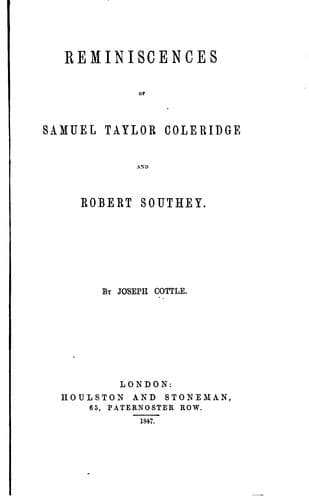
Reminiscences of Samuel Taylor Coleridge and Robert SoutheyCottle, Joseph
General
Reminiscences of Samuel Taylor Coleridge and Robert Southey
Cottle, Joseph
Authors, English -- 19th century -- Biography; Coleridge, Samuel Taylor, 1772-1834; Southey, Robert, 1774-1843
Pombal, whose heart was bad, though he made a good minister, reduced the
church during his administration. He suffered no persons to enter the
convents, and, as the old monks and nuns died, threw two convents into
one, and sold the other estates. By this means, he would have annihilated
the whole generation of vermin; but the king died, and the queen, whose
religion has driven her mad, undid, through the influence of the priests,
all that Pombal had done. He escaped with his life, but lived to see his
bust destroyed, and all his plans for the improvement of Portugal
reversed. He had the interest of his country at heart, and the
punishment, added to the regret of having committed so many crimes to
secure his power, must almost have been enough for this execrable
marquis.
The climate here is delightful, and the air so clear, that when the moon
is young, I can often distinguish the whole circle, thus; O. You and
Robert may look for this some fine night, but I do not remember ever to
have observed it in England. The stars appear more brilliant here, but I
often look up at the Pleiades, and remember how much happier I was when I
saw them in Bristol. Fare you well. Let me know that my friends remember
me....
Robert Southey."
After the complete reconciliation had taken place with Mr. Coleridge, Mr.
Southey in the autumn of 1796, settled in London, and purposed to study
the law. From London he sent me the following letter.
"London, Nov. 1796.
My dear friend,
I am now entering on a new way of life which will lead me to
independence. You know that I neither lightly undertake any scheme, nor
lightly abandon what I have undertaken. I am happy because I have no
want, and because the independence I labour to attain, and of attaining
which, my expectations can hardly be disappointed, will leave me nothing
to wish. I am indebted to you, Cottle, for the comforts of my later time.
In my present situation I feel a pleasure in saying thus much.
Thank God! Edith comes on Monday next. I say Thank God, for I have never
since my return from Portugal, been absent from her so long before, and
sincerely hope and intend never to be so again. On Tuesday we shall be
settled, and on Wednesday my legal studies begin in the morning, and I
shall begin with 'Madoc' in the evening. Of this it is needless to
caution you to say nothing; as I must have the character of a lawyer; and
though I can and will unite the two pursuits, no one would credit the
possibility of the union. In two years the Poem shall be finished, and
the many years it must lie by will afford ample time for correction.
Public-domain text, read in full here on John Shaqi.
Reviews
Reviews
No reviews yet
Be the first to share your thoughts on this work.
Elsewhere in the archive
Join the Discussion
Join the discussion
Sign in to leave a comment or review.
Sign InorCreate an account