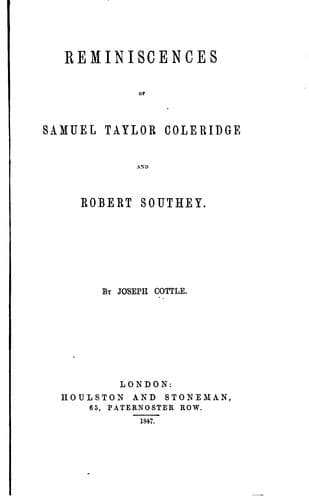
Reminiscences of Samuel Taylor Coleridge and Robert SoutheyCottle, Joseph
General
Reminiscences of Samuel Taylor Coleridge and Robert Southey
Cottle, Joseph
Authors, English -- 19th century -- Biography; Coleridge, Samuel Taylor, 1772-1834; Southey, Robert, 1774-1843
Mr. Southey mentioned to me the last time I saw him, the jeopardy in
which he had recently been placed, through his 'killing off'; and from
which danger he was alone saved by his anonymous garb. He said he had
found it necessary in reviewing a book, written by a native of the
emerald isle, to treat it with rather unwonted severity, such as it
richly deserved. A few days after the critique had appeared, he happened
to call on a literary friend, in one of the inns of court. They were
conversing on this work, and the incompetence of the writer, when the
author, a gigantic Irishman entered the room, in a great rage, and vowing
vengeance against the remorseless critic. Standing very near Mr. Southey,
he raised his huge fist, and exclaimed, "And, if I knew who it was, I'd
hate him!" Mr. S. observed a very profound silence, and not liking the
vicinity of a volcano, quietly retired, reserving his laugh for a less
hazardous occasion.
Mr. Southey in a letter, June 18, 1807, thus expresses himself. "...
Beyond the fascinations of poetry, there is a calmer and steadier
pleasure in acquiring and communicating the knowledge of what has been,
and of what is. I am passionately fond of history, even when I have been
delighted with the act of poetical composition. The recollection that all
was fable in the story with which I have exerted myself, frequently
mingled with the delight. I am better pleased in rendering justice to the
mighty dead; with the holding up to the world, of kings, conquerors,
heroes, and saints, not as they have been usually held up, but as they
really are, good or evil, according to the opinion formed of them, by one
who has neither passion, prejudice, nor interest, of any kind to mislead
his mind.
There is a delight in recording great actions, and, though of a different
kind, in execrating bad ones, beyond anything which Poetry can give, when
it departs from historical truth. There is also a sense of power, even
beyond what the poet, creator as he is, can exercise. It is before _my_
earthly tribunal, that these mighty ones are brought for judgment.
Centuries of applause, trophies, and altars, or canonizations, or
excommunications, avail nothing with me. No former sentences are
cognizable in my court. The merits of the case are all I look to, and I
believe I have never failed to judge of the actions by themselves, and of
the actor by his motives; and to allow manners, opinions, circumstances,
&c., their full weight in extenuation. What other merit my historical
works may have, others must find out for themselves, but this will I
vouch for, that never was the heart of any historian fuller of purer
opinions; and that never any one went about his work with more thorough
industry, or more thorough good-will.
Your account of Churchey is very amusing, I should like to see the
pamphlet of which you speak.[64] God bless you.
Yours affectionately,
Robert Southey."
"Keswick, March 16, 1810.
My dear Cottle,
Public-domain text, read in full here on John Shaqi.
Reviews
Reviews
No reviews yet
Be the first to share your thoughts on this work.
Elsewhere in the archive
Join the Discussion
Join the discussion
Sign in to leave a comment or review.
Sign InorCreate an account