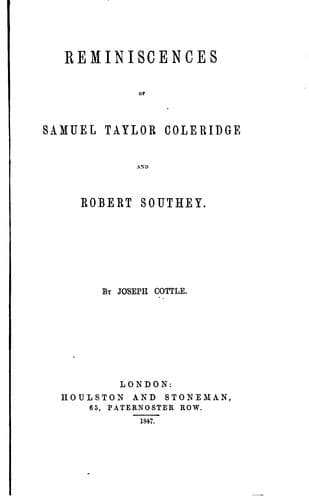
Reminiscences of Samuel Taylor Coleridge and Robert SoutheyCottle, Joseph
General
Reminiscences of Samuel Taylor Coleridge and Robert Southey
Cottle, Joseph
Authors, English -- 19th century -- Biography; Coleridge, Samuel Taylor, 1772-1834; Southey, Robert, 1774-1843
A short time after the receipt of this invitation, Mr. Coleridge arrived
in Bristol from Germany, and as he was about to pay Mr. Wordsworth a
visit, he pressed me to accompany him. I had intended a journey to
London, and now determined on proceeding with so agreeable a companion,
and on so pleasant a journey and tour; taking the metropolis on my
return. To notice the complicated incidents which occurred on this tour,
would occupy a large space. I therefore pass it all over, with the
remark, that in this interview with Mr. Wordsworth, the subject of the
"Lyrical Ballads" was mentioned but once, and that casually, and only to
account for its failure! which Mr. W. ascribed to two causes; first the
"Ancient Mariner," which, he said, no one seemed to understand; and
secondly, the unfavorable notice of most of the reviews.
On my reaching London, having an account to settle with Messrs. Longman
and Rees, the booksellers of Paternoster Row, I sold them all my
copyrights, which were valued as one lot, by a third party. On my next
seeing Mr. Longman, he told me, that in estimating the value of the
copyrights, Fox's "Achmed," and Wordsworth's "Lyrical Ballads," were
"reckoned _as nothing_." "That being the case," I replied, "as both these
authors are my personal friends, I should be obliged, if you would return
me again these two copyrights, that I may have the pleasure of presenting
them to the respective writers." Mr. Longman answered, with his
accustomed liberality, "You are welcome to them." On my reaching Bristol,
I gave Mr. Fox his receipt for twenty guineas; and on Mr. Coleridge's
return from the north, I gave him Mr. Wordsworth's receipt for his thirty
guineas; so that whatever advantage has arisen, subsequently, from the
sale of this volume of the "Lyrical Ballads," I am happy to say, has
pertained exclusively to Mr. W.
I have been the more particular in these statements, as it furnishes,
perhaps, the most remarkable instance on record, of a volume of Poems
remaining for so long a time, almost totally neglected, and afterwards
acquiring, and that in a rapid degree, so much deserved popularity.[71]
A month or two after Mr. Coleridge had left Bristol for Germany, Dr.
Beddoes told me of a letter he had just received from his friend, Davies
Giddy, (afterward with the altered name of Gilbert, President of the
Royal Society) recommending a very ingenious young chemist, of Penzance,
in Cornwall, to assist him in his Pneumatic Institution, at the Hotwells.
"The character is so favourable," said the Dr. "I think I shall engage
him;" handing me the letter. I read it, and replied, "You cannot err in
receiving a young man thus recommended." Two or three weeks after, Dr. B.
introduced me to no other than Mr. afterwards Sir. Humphrey Davy. (Mr.
Giddy little thought that this "young chemist of Penzance," was destined
to precede himself, in occupying the chair of Newton.)
Public-domain text, read in full here on John Shaqi.
Reviews
Reviews
No reviews yet
Be the first to share your thoughts on this work.
Elsewhere in the archive
Join the Discussion
Join the discussion
Sign in to leave a comment or review.
Sign InorCreate an account