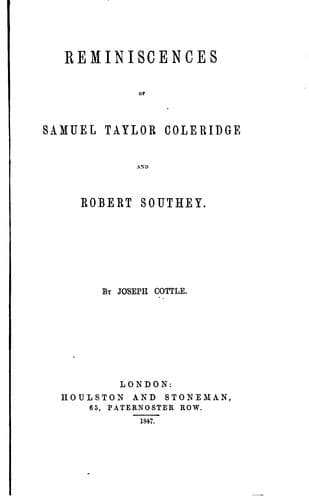
Reminiscences of Samuel Taylor Coleridge and Robert SoutheyCottle, Joseph
General
Reminiscences of Samuel Taylor Coleridge and Robert Southey
Cottle, Joseph
Authors, English -- 19th century -- Biography; Coleridge, Samuel Taylor, 1772-1834; Southey, Robert, 1774-1843
Some mitigation was now in store for Mr. C. arising out of a whimsical
circumstance. He had been placed as a sentinel, at the door of a
ball-room, or some public place of resort, when two of his officers,
passing in, stopped for a moment, near Mr. C., talking about Euripides,
two lines from whom, one of them repeated. At the sound of Greek, the
sentinel instinctively turned his ear, when he said, with all deference,
touching his lofty cap, "I hope your honour will excuse me, but the lines
you have repeated are not quite accurately cited. These are the lines,"
when he gave them in their more correct form. "Besides," said Mr. C.,
"instead of being in Euripides, the lines will be found in the second
antistrophe of the 'Aedipus of Sophocles.'" "Why, man, who are you?" said
the officer, "old Faustus ground young again?" "I am your honour's humble
sentinel," said Mr. C., again touching his cap.
The officers hastened into the room, and inquired of one and another,
about that "odd fish," at the door; when one of the mess, (it is
believed, the surgeon) told them, that he had his eye upon him, but he
would neither tell where he came from, nor anything about his family of
the Cumberbatches; "but," continued he, "instead of his being an 'odd
fish,' I suspect he must be a 'stray bird' from the Oxford or Cambridge
aviary." They learned also, the laughable fact, that he was bruised all
over, by frequent falls from his horse. "Ah," said one of the officers,
"we have had, at different times, two or three of these 'University
birds' in our regiment." This suspicion was confirmed by one of the
officers, Mr. Nathaniel Ogle, who observed that he had noticed a line of
Latin, chalked under one of the men's saddles, and was told, on inquiring
whose saddle it was, that it was "Cumberbatch's."
The officers now kindly took pity on the 'poor scholar' and had Mr. C.
removed to the medical department, where he was appointed assistant in
the regimental hospital. This change was a vast improvement in Mr. C.'s
condition; and happy was the day, also, on which it took place, for the
sake of the sick patients; for Silas Tomken Cumberbatch's amusing
stories, they said, did them more good than all the doctor's physic! Many
ludicrous dialogues sometimes occurred between Mr. C. and his new
disciples; particularly with one who was "the geographer." The following
are some of these dialogues.
If he began talking to one or two of his comrades; for they were all on a
perfect equality, except that those who went through their exercise the
best, stretched their necks a little above the "awkward squad;" in which
ignoble class Mr. C. was placed, as the preeminent member, almost by
acclamation; if he began to speak, notwithstanding, to one or two, others
drew near, increasing momently, till by-and-bye the sick-beds were
deserted, and Mr. C. formed the centre of a large circle.
Public-domain text, read in full here on John Shaqi.
Reviews
Reviews
No reviews yet
Be the first to share your thoughts on this work.
Elsewhere in the archive
Join the Discussion
Join the discussion
Sign in to leave a comment or review.
Sign InorCreate an account