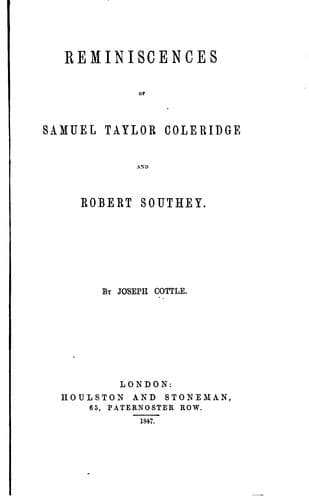
Reminiscences of Samuel Taylor Coleridge and Robert SoutheyCottle, Joseph
General
Reminiscences of Samuel Taylor Coleridge and Robert Southey
Cottle, Joseph
Authors, English -- 19th century -- Biography; Coleridge, Samuel Taylor, 1772-1834; Southey, Robert, 1774-1843
"With faery wand, O bid the maid arise,
Chaste joyance dancing in her bright blue eyes,
As erst, when, from the Muse's calm abode,
I came with learning's meed not unbestowed."
See Poems, Edit. 1805, p. 34.
He wrote, to my certain knowledge, for the prize in the ensuing year;
but it was most deservedly given to Keate's beautiful Ode. The
subject Laus Astronomiae. No one was more convinced of the propriety
of the decision than Coleridge himself. He used to repeat Ramsden's
Greek Ode on Gibraltar, and Smith's Latin one on Mare Liberum, with
incessant rapture. It would have been his glory to have caught their
spirit,--he was absorbed in these things. A Classical Tripos would
have changed Coleridge's destiny."--_Gentleman's Magazine_, Dec.
1834.
* * * * *
The reader's attention will now be directed to Mr. Coleridge, after he
left Malta, when he visited Bristol, in the year 1807. I accidentally
learned that Mr. C. had returned to England, not in good health, and that
he was at Mr. Poole's, when I addressed a letter to him, expressing a
hope that his health would soon allow him to pay me a visit, in Bristol.
To this letter he thus replied:
"Dear Cottle,
On my return to Bristol, whenever that may be, I will certainly give you
the right hand of old fellowship; but, alas! you will find me the
wretched wreck of what you knew me, rolling, rudderless. My health is
extremely bad. Pain I have enough of, but that is indeed to me, a mere
trifle, but the almost unceasing, overpowering sensations of
wretchedness: achings in my limbs, with an indescribable restlessness,
that makes action to any available purpose, almost impossible: and worst
of all, the sense of blighted utility, regrets, not remorseless. But
enough; yea, more than enough; if these things produce, or deepen the
conviction of the utter powerlessness of ourselves, and that we either
perish, or find aid from something that passes understanding.
Affectionately,
S. T. C."
Public-domain text, read in full here on John Shaqi.
Reviews
Reviews
No reviews yet
Be the first to share your thoughts on this work.
Elsewhere in the archive
Join the Discussion
Join the discussion
Sign in to leave a comment or review.
Sign InorCreate an account