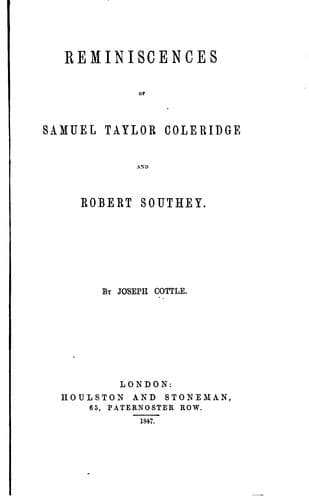
Reminiscences of Samuel Taylor Coleridge and Robert SoutheyCottle, Joseph
General
Reminiscences of Samuel Taylor Coleridge and Robert Southey
Cottle, Joseph
Authors, English -- 19th century -- Biography; Coleridge, Samuel Taylor, 1772-1834; Southey, Robert, 1774-1843
Some weeks after, Mr. Coleridge called on me; when, in the course of
conversation, he entered into some observations on his own character,
that made him appear unusually amiable. He said that he was naturally
very arrogant; that it was his easily besetting sin; a state of mind
which he ascribed to the severe subjection to which he had been exposed,
till he was fourteen years of age, and from which, his own consciousness
of superiority made him revolt. He then stated that he had renounced all
his Unitarian sentiments; that he considered Unitarianism as a heresy of
the worst description; attempting in vain, to reconcile sin and holiness;
the world and heaven; opposing the whole spirit of the Bible; and
subversive of all that truly constituted christianity. At this interview
he professed his deepest conviction of the truth of Revelation; of the
Fall of Man; of the Divinity of Christ, and redemption alone through his
blood. To hear these sentiments so explicitly avowed, gave me unspeakable
pleasure, and formed a new, and unexpected, and stronger bond of union.
A long and highly interesting theological conversation; followed, in
which Mr. C. proved, that, however weak his body, the intellectual vigour
of his mind was unimpaired. He exhibited, also, more sobriety of manner
than I had before noticed in him, with an improved and impressive
maturity in his reflections, expressed in his happiest language; and
which, could it have been accurately recorded, would have adorned the
most splendid of his pages;--so rare and pre-eminent was the powerful and
spontaneous utterance with which this gifted son of genius was endowed.
Mr. Coleridge, at his next visit, related to me some of his Italian
adventures; one or two of which I here introduce.
After quitting Malta, he had landed in Sicily, and visited Etna; his
ascent up whose side, to the crater, he graphically described, with some
striking features; but as this is a subject proverbially enlarged upon by
all travellers, I waive further notice, and proceed to state, that Mr. C.
after leaving Sicily passed over to the south of Italy, and journeyed on
to Rome.
Shortly after Mr. Coleridge had arrived in this city, he attracted some
notice amongst the literati, as an English "Man of Letters." Cardinal
Fesch, in particular, was civil, and sought his company; but that which
was more remarkable, Jerome Buonaparte was then a resident at Rome, and
Mr. C.'s reputation becoming known to him, he sent for him, and after
showing him his palace, pictures, &c. thus generously addressed him:
"Sir, I have sent for you to give you a little candid advice. I do not
know that you have said, or written anything against my brother Napoleon,
but as an Englishman, the supposition is not unreasonable. If you have,
my advice is, that you leave Italy as soon as you possibly can!"
Public-domain text, read in full here on John Shaqi.
Reviews
Reviews
No reviews yet
Be the first to share your thoughts on this work.
Elsewhere in the archive
Join the Discussion
Join the discussion
Sign in to leave a comment or review.
Sign InorCreate an account