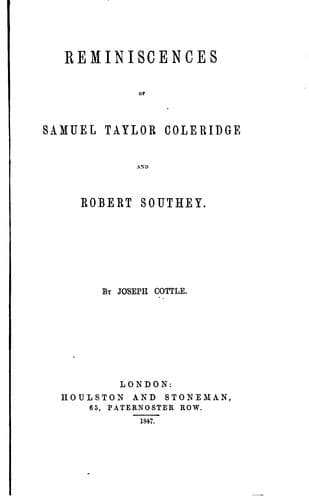
Reminiscences of Samuel Taylor Coleridge and Robert SoutheyCottle, Joseph
General
Reminiscences of Samuel Taylor Coleridge and Robert Southey
Cottle, Joseph
Authors, English -- 19th century -- Biography; Coleridge, Samuel Taylor, 1772-1834; Southey, Robert, 1774-1843
As soon as the ship had cleared the port, Mr. Coleridge hastened down to
the cabin, and cried, "my dear captain, tell me how you obtained my
passport?" Said the captain, very gravely, "Why, I went to the
authorities, and _swore_ that you were an _American_, and my steward! I
_swore_ also, that I knew your father and mother; that they lived in a
red-brick house, about half a mile out of New York, on the road to
Boston!"
It is gratifying to add, that this benevolent little-scrupulous captain
refused to accept any thing from Mr. C. for his passage to England; and,
behaved in many other respects, with the same uniform kindness. During
the voyage, Mr. Coleridge told me, he was attacked with a dangerous
illness, when he thought he should have _died_, but for the "_good
captain_," who attended him with the solicitude of a father. Mr. C. also
said, had he known what the captain was going to _swear_, whatever the
consequences might have been, he would have prevented him.[82]
The following long letter will be read with interest.
"Bristol, 1807.
Dear Cottle,
To pursue our last conversation. Christians expect no outward or sensible
miracles from prayer. Its effects, and its fruitions are spiritual, and
accompanied says that _true Divine_, Archbishop Leighton, 'not by reasons
and arguments, but by an inexpressible kind of evidence, which they only
know who have it.'
To this I would add, that even those who, like me I fear, have not
attained it, yet may presume it. First, because reason itself, or rather
mere human nature, in any dispassionate moment, feels the necessity of
religion, but if this be not true there is no religion, no religation, or
binding over again; nothing added to reason, and therefore _Socinianism_,
misnamed _Unitarianism_, is not only not _Christianity_, it is not even
_religion_, it does not _religate_; does not bind anew. The first outward
and sensible result of prayer is, a penitent resolution, joined with a
consciousness of weakness in effecting it, yea even a dread, too well
grounded, lest by breaking and falsifying it, the soul should add guilt
to guilt; by the very means it has taken to escape from guilt; so
pitiable is the state of unregenerate man.
Are you familiar with Leighton's Works? He resigned his archbishoprick,
and retired to voluntary poverty on account of the persecutions of the
Presbyterians, saying, 'I should not dare to introduce christianity
itself with such cruelties, how much less for a surplice, and the name of
a bishop.' If there could be an intermediate space between inspired, and
uninspired writings, that space would be occupied by Leighton. No show of
learning, no appearance, or ostentatious display of eloquence, and yet
both may be shown in him, conspicuously and holily. There is in him
something that must be felt, even as the scriptures must be felt.
Public-domain text, read in full here on John Shaqi.
Reviews
Reviews
No reviews yet
Be the first to share your thoughts on this work.
Elsewhere in the archive
Join the Discussion
Join the discussion
Sign in to leave a comment or review.
Sign InorCreate an account