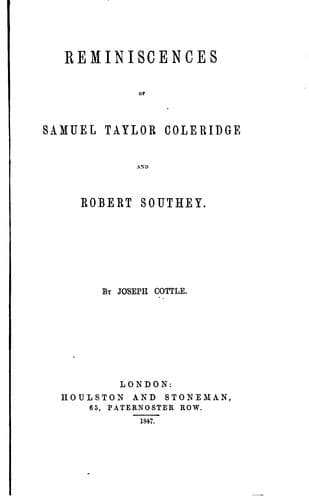
Reminiscences of Samuel Taylor Coleridge and Robert SoutheyCottle, Joseph
General
Reminiscences of Samuel Taylor Coleridge and Robert Southey
Cottle, Joseph
Authors, English -- 19th century -- Biography; Coleridge, Samuel Taylor, 1772-1834; Southey, Robert, 1774-1843
Some of his theological observations are here detailed. He said, he had
recently had a long conversation with an Unitarian minister, who
declared, that, he could discover nothing in the New Testament which in
the _least_ favoured the Divinity of Christ, to which Mr. C. replied that
it appeared to him impossible for any man to read the New Testament, with
the common exercise of an unbiassed understanding, without being
convinced of the Divinity of Christ, from the testimony almost of every
page.
He said it was evident that different persons might look at the same
object with very opposite feelings. For instance, if Sir Isaac Newton
looked at the planet Jupiter, he would view him with his revolving moons,
and would be led to the contemplation of his being inhabited, which
thought would open a boundless field to his imagination: whilst another
person, standing perhaps at the side of the great philosopher, would look
at Jupiter with the same set of feelings that he would at a silver
sixpence. So some persons were wilfully blind, and did not seek for that
change, that preparation of the heart and understanding, which would
enable them to see clearly the gospel truth.
He said that Socinians believed no more than St. Paul did before his
conversion: for the Pharisees believed in a Supreme Being, and a future
state of rewards and punishments. St. Paul thought he ought to do many
things contrary to the name of Jesus of Nazareth. The saints he shut up
in prison, having received authority from the High Priest, and when they
were put to death, he gave his voice against them. But after his
conversion, writing to the Romans, he says, 'I am not ashamed of the
gospel of Christ, for it is the power of God to salvation unto every man
that believeth: to the Jew first, and also to the Gentiles.'
He then referred to the dreadful state of the literati in London, as it
respects religion, and of their having laughed at him, and believed him
to be in jest, when he professed his belief in the Bible.
Having introduced Mr. Davy to Mr. C. some years before, I inquired for
him with some anxiety, and expressed a hope that he was not tinctured
with the prevailing scepticism since his removal from Bristol to London.
Mr. C. assured me that he was not: that _his_ heart and understanding
were not the _soil_ for _infidelity_.[84] I then remarked, "During your
stay in London, you doubtless saw a great many of what are called 'the
cleverest men,' how do you estimate Davy, in comparison with these?" Mr.
Coleridge's reply was strong, but expressive. "Why, Davy could eat them
all! There is an energy, an elasticity in his mind, which enables him to
seize on, and analyze, all questions, pushing them to their legitimate
consequences. Every subject in Davy's mind has the principle of vitality.
Living thoughts spring up like the turf under his feet." With equal
justice, Mr. Davy entertained the same exalted opinion of Mr. Coleridge.
Public-domain text, read in full here on John Shaqi.
Reviews
Reviews
No reviews yet
Be the first to share your thoughts on this work.
Elsewhere in the archive
Join the Discussion
Join the discussion
Sign in to leave a comment or review.
Sign InorCreate an account