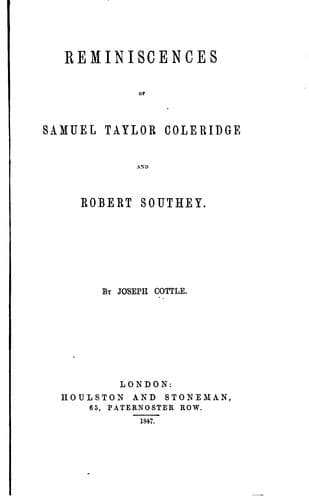
Reminiscences of Samuel Taylor Coleridge and Robert SoutheyCottle, Joseph
General
Reminiscences of Samuel Taylor Coleridge and Robert Southey
Cottle, Joseph
Authors, English -- 19th century -- Biography; Coleridge, Samuel Taylor, 1772-1834; Southey, Robert, 1774-1843
... The common end of all narrative, nay, of all poems is, to convert a
series into a whole, to make those events, which, in real or imagined
history, move on in a straight line, assume to our understandings a
circular motion--the snake with its tail in its mouth. Hence, indeed, the
almost flattering and yet appropriate term, Poesy, i. e.
Poieses--_making_. Doubtless, to His eye, which alone comprehends all
past and all future, in one eternal, what to our short sight appears
straight, is but a part of the great cycle, just as the calm sea to us
appears level, though it be indeed only a part of the globe. Now what the
globe is in geography, miniaturing in order to manifest the truth, such
is a poem to that image of God, which we were created into, and which
still seeking that unity, or revelation of the one, in and by the many,
which reminds it, that though in order to be an individual being, it must
go farther from God; yet as the receding from him, is to proceed toward
nothingness and privation, it must still at every step turn back toward
him, in order to be at all. A straight line continually retracted, forms
of necessity a circular orbit. Now God's will and word CANNOT be
frustrated. His fiat was, with ineffable awfulness, applied to man, when
all things, and all living things, and man himself, (as a mere animal)
included, were called forth by the Universal, 'Let there be,' and then
the breath of the Eternal superadded, to make an immortal
spirit--immortality being, as the author of the 'Wisdom of Soloman'
profoundly expresses it, 'the only possible reflex, or image of
eternity.' The immortal finite is the contracted shadow of the eternal
Infinite. Therefore nothingness, or death, to which we move, as we recede
from God and from the Word, cannot be nothing; but that tremendous medium
between nothing and true being, which Scripture and inmost reason present
as most, most horrible!
Affectionately,
S. T. C."
The following letter to Mr. Wade has no date.
"Tuesday night, i. e. Wednesday morning.
My best and dearest friend,
I have barely time to scribble a few lines, so as not to miss the post,
for here as every where, there are charitable people, who, taking for
granted that you have no business of your own, would save from the pain
of vacancy, by employing you in theirs.
As to the letter you propose to write to a man who is unworthy even of a
rebuke from you, I might most unfeignedly object to some parts of it,
from a pang of conscience forbidding me to allow, even from a dear
friend, words of admiration, which are inapplicable in exact proportion
to the power given to me of having deserved them, if I had done my duty.
Public-domain text, read in full here on John Shaqi.
Reviews
Reviews
No reviews yet
Be the first to share your thoughts on this work.
Elsewhere in the archive
Join the Discussion
Join the discussion
Sign in to leave a comment or review.
Sign InorCreate an account