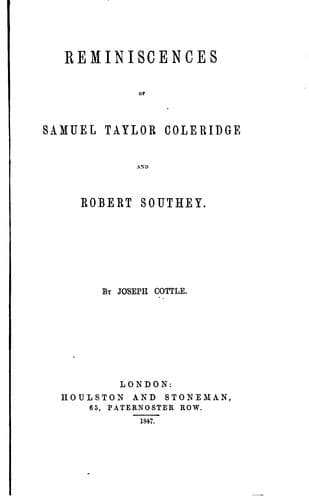
Reminiscences of Samuel Taylor Coleridge and Robert SoutheyCottle, Joseph
General
Reminiscences of Samuel Taylor Coleridge and Robert Southey
Cottle, Joseph
Authors, English -- 19th century -- Biography; Coleridge, Samuel Taylor, 1772-1834; Southey, Robert, 1774-1843
Another powerful reason, which should reconcile the friends of Mr.
Coleridge to this detail of his destructive habits, arises from the
recollection that the pain given to their minds, is present and
temporary. They should wisely consider that, though they regret, their
regrets, like themselves, as time rolls on, are passing away! but the
example,--this clear, full, incontestable example, _remains!_ And who can
estimate the beneficial consequences of this undisguised statement to
numerous succeeding individuals? It is consolatory to believe, that had I
written nothing else, this humble but unflinching narrative would be an
evidence that I had not lived in vain.
When it is considered also, how many men of high mental endowments, have
shrouded their lustre, by a passion for this stimulus, and thereby,
prematurely, become fallen spirits: would it not be a criminal concession
to unauthorized feelings, to allow so impressive an exhibition of this
subtle species of intemperance to escape from public notice; and, that no
discredit might attach to the memory of the individual we love, to
conceal an example, fraught with so much instruction, brought out into
full display? In the exhibition here made, the inexperienced, in future,
may learn a memorable lesson, and be taught to shrink from opium, as they
would from a scorpion; which, before it destroys, invariably expels peace
from the mind, and excites the worst species of conflict, that of setting
a man at war with himself.
The most expressive and pungent of all Mr. Coleridge's self-upbraidings,
is that, in which he thrills the inmost heart, by saying, with a
sepulchral solemnity, "I have learned what a sin is against an infinite,
imperishable being, such as is the soul of man!" And yet, is this, and
such as this, to be devoted to forgetfulness, and all be sacrificed, lest
some friend, disdaining utility, should prefer flattery to truth? A
concession to such advice would be treachery and pusillanimity combined,
at which none would so exult as the spirits of darkness.
If some of the preceding language should be deemed too strong, by those
who take but a contracted view of the subject, and who would wish to
screen the dead, rather than to improve the living, let them judge what
their impressions would be, in receiving, like myself, at this time, the
communications from Mr. C. which will subsequently appear, and then
dispassionately ask themselves, whether such impressive lessons of
instruction ought to be doomed to oblivion.
* * * * *
The following letter to Mr. Wade, has no date, but the post-mark
determines it to have been Dec. 8, 1813.
Public-domain text, read in full here on John Shaqi.
Reviews
Reviews
No reviews yet
Be the first to share your thoughts on this work.
Elsewhere in the archive
Join the Discussion
Join the discussion
Sign in to leave a comment or review.
Sign InorCreate an account