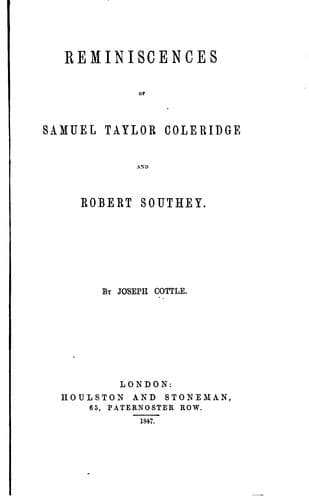
Reminiscences of Samuel Taylor Coleridge and Robert SoutheyCottle, Joseph
General
Reminiscences of Samuel Taylor Coleridge and Robert Southey
Cottle, Joseph
Authors, English -- 19th century -- Biography; Coleridge, Samuel Taylor, 1772-1834; Southey, Robert, 1774-1843
I should here mention, that Mr. Coleridge's lectures bore but a small
resemblance to the polished compositions of Sir James Mackintosh. They
were all of a conversational character, and were little other than the
earnest harangues, with which on all possible occasions, he indulged his
friends, so that there was little of the toil of preparation with him,
and if the demand had been equal to the supply, he might have lectured
continuously. But if there was little of formal and finished composition
in Mr. C.'s lectures, there were always racy and felicitous passages,
indicating deep thought, and indicative of the man of genius; so that if
polish was not always attained, as one mark of excellence, the attention
of his hearers never flagged, and his large dark eyes, and his
countenance, in an excited state, glowing with intellect, predisposed his
audience in his favor.
It may here be mentioned, that in the year 1814, when Buonaparte was
captured and sent to Elba, the public, expression of joy burst forth in a
general illumination; when Mr. Josiah Wade, wishing to display a large
transparency, applied to his friend Mr. Coleridge, then residing with
him, for a subject, as a guide to his ingenious painter, of which the
following is a copy, from Mr. C.'s original.
The four lines were chosen, of which the two last have something of a
prophetic aspect.
"On the right side of the transparency, a rock with the word Elba on
it: chained to this by one leg, put a vulture with the head of
Napoleon Buonaparte; then a female genius, representing BRITANNIA, in
a bending posture, with one hand holding out one wing of the vulture,
and with the other clipping it with a large pair of shears; on the
one half of which appears either the word 'WELLINGTON,' or the word
'ARMY,' and on the other, either 'NELSON,' or else 'NAVY;' I should
prefer WELLINGTON and NELSON, but that I fear Wellington may be a
word of too many letters. Behind Britannia, and occupying the right
side of the transparency, a slender gilded column, with 'TRADE' on
its base, and the cap of liberty on its top; and on one side, leaning
against it, a trident laurelled, and on the other a laurelled sword.
At the top of the transparency, and quite central, a dove, with an
olive branch, may be hovering over the bending figure of Britannia.
N. B.--The trident to be placed with the points upwards, the sword
with its hilt upwards.
We've conquer'd us a PEACE, like lads true metall'd:
And bankrupt NAP.'S accompts seem all now settled.
OR THUS.
We've fought for peace, and conquer'd it at last,
The rav'ning vulture's leg seems fetter'd fast!
Britons, rejoice! and yet be wary too;
The chain may break, the clipt wing sprout anew."
Public-domain text, read in full here on John Shaqi.
Reviews
Reviews
No reviews yet
Be the first to share your thoughts on this work.
Elsewhere in the archive
Join the Discussion
Join the discussion
Sign in to leave a comment or review.
Sign InorCreate an account