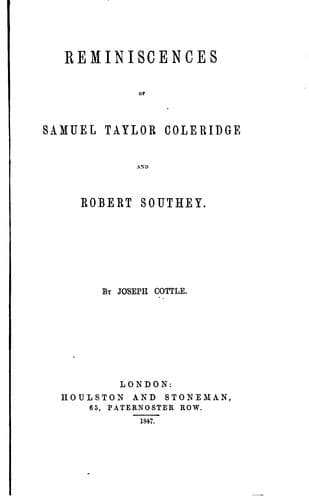
Reminiscences of Samuel Taylor Coleridge and Robert SoutheyCottle, Joseph
General
Reminiscences of Samuel Taylor Coleridge and Robert Southey
Cottle, Joseph
Authors, English -- 19th century -- Biography; Coleridge, Samuel Taylor, 1772-1834; Southey, Robert, 1774-1843
You may imagine with what feelings I have read your correspondence with
Coleridge. Shocking as his letters are, perhaps the most mournful thing
they discover is, that while acknowledging the guilt of the habit, he
imputes it still to morbid bodily causes, whereas after every possible
allowance is made for these, every person who has witnessed his habits,
knows that for the greater, infinitely the greater part, inclination and
indulgence are its motives.
It seems dreadful to say this, with his expressions before me, but it is
so, and I know it to be so, from my own observation, and that of all with
whom he has lived. The Morgans, with great difficulty and perseverance,
_did_ break him of the habit, at a time when his ordinary consumption of
laudanum was, from _two quarts a week_, to _a pint a day!_ He suffered
dreadfully during the first abstinence, so much so, as to say it was
better for him to die than to endure his present feelings. Mrs. Morgan
resolutely replied, it was indeed better that he should die, than that he
should continue to live as he had been living. It angered him at the
time, but the effort was persevered in.
To what then was the relapse owing? I believe to this cause--that no use
was made of renewed health and spirits; that time passed on in idleness,
till the lapse of time brought with it a sense of neglected duties, and
then relief was again sought for _a self-accusing mind_;--in bodily
feelings, which when the stimulus ceased to act, added only to the load
of self-accusation. This Cottle, is an insanity which none but the soul's
physician can cure. Unquestionably, restraint would do as much for him as
it did when the Morgans tried it, but I do not see the slightest reason
for believing it would be more permanent. This too I ought to say, that
all the medical men to whom Coleridge has made his confession, have
uniformly ascribed the evil, not to bodily disease, but indulgence. The
restraint which alone could effectually cure, is that which no person can
impose upon him. Could he be compelled to a certain quantity of labour
every day, _for his family_, the pleasure of having done it would make
his heart glad, and the sane mind would make the body whole.
Public-domain text, read in full here on John Shaqi.
Reviews
Reviews
No reviews yet
Be the first to share your thoughts on this work.
Elsewhere in the archive
Join the Discussion
Join the discussion
Sign in to leave a comment or review.
Sign InorCreate an account