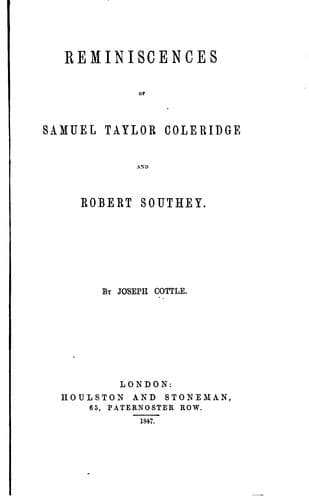
Reminiscences of Samuel Taylor Coleridge and Robert SoutheyCottle, Joseph
General
Reminiscences of Samuel Taylor Coleridge and Robert Southey
Cottle, Joseph
Authors, English -- 19th century -- Biography; Coleridge, Samuel Taylor, 1772-1834; Southey, Robert, 1774-1843
After my death, I earnestly entreat, that a full and unqualified
narration of my wretchedness, and of its guilty cause, may be made
public, that at least, some little good may be effected by the direful
example.
May God Almighty bless you, and have mercy on your still affectionate,
and in his heart, grateful--
S. T. Coleridge."
This is indeed a redeeming letter. We here behold Mr. Coleridge in the
lowest state of human depression, but his condition is not hopeless. It
is not the insensibility of final impenitence; it is not the slumber of
the grave. A gleam of sunshine bursts through the almost impenetrable
gloom; and the virtue of that prayer "May God Almighty have mercy!" in a
penitent heart, like his, combined as we know it was, with the
recognition of Him, who is "the Way, the Truth, and the Life," authorizes
the belief, that a spirit thus exercised, had joys in reserve, and was to
become the recipient of the best influences that can illumine regenerate
man.
No individual ever effected great good in the moral world, who had not
been subjected to a long preliminary discipline; and he who knows what is
in man; who often educes good from evil, can best apportion the exact
kind and degree, indispensable to each separate heart. Mr. Coleridge,
after this time, lived twenty years. A merciful providence, though with
many mementos of decay, preserved his body, and in all its vigor
sustained his mind. Power was given him, it is presumed, and fervently
hoped, to subdue his former pernicious practices. The season of solemn
reflection it is hoped arrived, that his ten talents were no longer
partially buried, but that the lengthened space extended to him, was
consecrated by deep reflection, and consequent qualification, to
elucidate and establish the everlasting principles of Christian truth.
Under such advantages, we are authorized in forming the highest
expectations from his Great Posthumous Work. Nothing which I have
narrated of Mr. Coleridge, will in the least subtract from the merit, or
the impression of that production, effected in his mature manhood, when
his renovated faculties sent forth new corruscations, and concentrated
the results of all his profound meditations. The very process to which he
had been exposed, so unpropitious as it appeared, may have been the most
favourable for giving consistency to his intellectual researches. He may
have thought in channels the more refined, varied, and luminous, from the
ample experience he had acquired, that the only real evil in this world,
was the frown of the Almighty, and His favor the only real good; so that
the grand work, about to appear, may add strength to the strong, and give
endurance to the finished pediment of his usefulness and his fame.
Public-domain text, read in full here on John Shaqi.
Reviews
Reviews
No reviews yet
Be the first to share your thoughts on this work.
Elsewhere in the archive
Join the Discussion
Join the discussion
Sign in to leave a comment or review.
Sign InorCreate an account