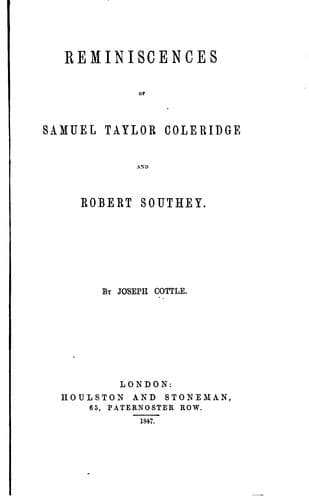
Reminiscences of Samuel Taylor Coleridge and Robert SoutheyCottle, Joseph
General
Reminiscences of Samuel Taylor Coleridge and Robert Southey
Cottle, Joseph
Authors, English -- 19th century -- Biography; Coleridge, Samuel Taylor, 1772-1834; Southey, Robert, 1774-1843
I have now to present the Reader with a series of letters from Mr.
Coleridge to the late Josiah and Thomas Wedgewood, Esqrs.; obligingly
communicated to me by Francis Wedgewood, Esq., of Etruria, son of Mr.
Josiah Wedgewood.
"May 21st, 1799. Gottingen.
My dear sir,
I have lying by my side six huge letters, with your name on each of them,
and all, excepting one, have been written for these three months. About
this time Mr. Hamilton, by whom I send this and the little parcel for my
wife, was, as it were, setting off for England; and I seized the
opportunity of sending them by him, as without any mock-modesty I really
thought that the expense of the postage to me and to you would be more
than their worth. Day after day, and week after week, was Hamilton going,
and still delayed. And now that it is absolutely settled that he goes
to-morrow, it is likewise absolutely settled that I shall go this day
three weeks, and I have therefore sent only this and the picture by him,
but the letters I will now take myself, for I should not like them to be
lost, as they comprize the only subject on which I have had an
opportunity of making myself thoroughly informed, and if I carry them
myself, I can carry them without danger of their being seized at
Yarmouth, as all my letters were, yours to ---- excepted, which were,
luckily, not sealed. Before I left England, I had read the book of which
you speak. I must confess that it appeared to me exceedingly illogical.
Godwin's and Condorcet's extravagancies were not worth confuting; and yet
I thought that the Essay on 'Population' had not confuted them. Professor
Wallace, Derham, and a number of German statistic, and
physico-theological writers had taken the same ground, namely, that
population increases in a geometrical, but the accessional nutriment only
in arithmetical ratio--and that vice and misery, the natural consequences
of this order of things, were intended by providence as the counterpoise.
I have here no means of procuring so obscure a book, as Rudgard's; but to
the best of my recollection, at the time that the Fifth Monarchy
enthusiasts created so great a sensation in England, under the
Protectorate, and the beginning of Charles the Second's reign, Rudgard,
or Rutgard (I am not positive even of the name) wrote an Essay to the
same purpose, in which he asserted, that if war, pestilence, vice, and
poverty, were wholly removed, the world could not exist two hundred
years, &c. Seiffmilts, in his great work concerning the divine order and
regularity in the destiny of the human race, has a chapter entitled a
confutation of this idea; I read it with great eagerness, and found
therein that this idea militated against the glory and goodness of God,
and must therefore be false,--but further confutation found I none!--This
book of Seiffmilts has a prodigious character throughout Germany; and
never methinks did a work less deserve it. It is in three huge octavos,
Public-domain text, read in full here on John Shaqi.
Reviews
Reviews
No reviews yet
Be the first to share your thoughts on this work.
Elsewhere in the archive
Join the Discussion
Join the discussion
Sign in to leave a comment or review.
Sign InorCreate an account