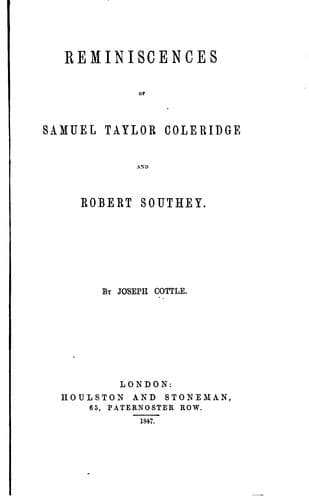
Reminiscences of Samuel Taylor Coleridge and Robert SoutheyCottle, Joseph
General
Reminiscences of Samuel Taylor Coleridge and Robert Southey
Cottle, Joseph
Authors, English -- 19th century -- Biography; Coleridge, Samuel Taylor, 1772-1834; Southey, Robert, 1774-1843
My original intention was, to prepare a memoir as a contribution to Mr.
Gillman's "Life of Mr. Coleridge." On my sending the MS. to Mr. Southey,
he observed, in his reply, "I apprehend if you send what you have written
about Coleridge and opium, it will not be made use of, and that
Coleridge's biographer will seek to find excuse for the abuse of that
drug."
I afterwards sent the MS. to my friend Mr. Foster, who had ever taken a
deep interest in all that concerns Mr. Coleridge. On returning it he thus
wrote.
"Stapleton, Dec. 19, 1835.
My dear sir,
I have read through your MS. volume, very much to the cost of my eyes,
but it was impossible to help going on, and I am exceedingly obliged to
you for favouring me with it;--the more so as there is no prospect of
seeing any large proportion of it in print. It is I think about as
melancholy an exhibition as I ever contemplated. Why was such a sad
phenomenon to come in sight on earth? Was it to abase the pride of human
intellect and genius?
You have done excellently well to collect into a permanent substance what
must else have gone into oblivion, for no one else could have exhibited
even a shadow of it. But now, my dear sir, I hope you are prepared with
the philosophy, or by whatever name I should designate the
fortitude,--that can patiently bear the frustration of the main immediate
purpose of your long and earnest labour.--For you may lay your account
that the compiler of the proposed life of Coleridge will admit but a very
minor part of what you have thus furnished at his request:--that
especially he will not admit what you feel to be the most important, as
an emphatic moral lesson, and what it has cost you the most painful
resolution to set faithfully forth.
No, my dear sir, the operator of the work will not, will not, will not,
let the illustrious philosopher, genius, and poet, so appear. He will get
over that stage with a few general expressions, and a few indistinctly
presented facts. And then as to the dreadful tragical parts, he will
promptly decide that it would be utter profanation to expose them to view
in any such unveiled prominence as you have exhibited in your narrative.
And then the solemn warning and example will be nearly kept out of sight.
Quite naturally that this would be the course adopted, unless the
compiler were, like yourself, intent, as his first and highest
obligation, on doing faithful homage to truth, virtue, and religion. How
I despise biography, as the business is commonly managed. I cannot
believe that Coleridge's dreadful letters of confession will be admitted
in their own unmodified form; though they ought to be. Most truly yours,
John Foster."
These combined intimations led me to stipulate that, whatever else was
omitted, the opium letters should be printed verbatim. But this being
promptly refused, I determined to throw my materials into a separate
work.
Public-domain text, read in full here on John Shaqi.
Reviews
Reviews
No reviews yet
Be the first to share your thoughts on this work.
Elsewhere in the archive
Join the Discussion
Join the discussion
Sign in to leave a comment or review.
Sign InorCreate an account