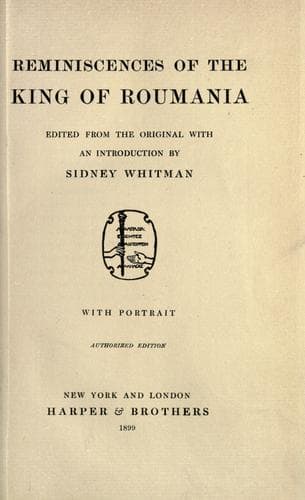
Reminiscences of the King of RoumaniaKremnitz, Mite
History
Reminiscences of the King of Roumania
Kremnitz, Mite
Carol I, King of Romania, 1839-1914; Eastern question (Balkan); Jews -- Romania; Romania -- History -- Charles I, 1866-1914
The unexpected news of the death of Napoleon III. was received at
Bucharest on January 10, 1873. Prince Charles and the Roumanian
nation were deeply moved by this sad event, for the dead Emperor
had been the champion and protector of the national existence of
Roumania in its darkest days. Throughout the whole land memorial
services were held, though the Metropolitan at first objected on
the ground that the late Emperor was not a member of the Orthodox
Church. The universal expression of sympathy with the widowed
Empress and the Prince Imperial created a certain friction with the
Republican Government, and the Foreign Minister reminded M. Strat
that the Roumanians ought not to forget that, after all, "it was to
France, and not the Emperor, that gratitude was due"! M. Thiers, the
President, also expressed his vexation that the Roumanian Chambers
should have sent messages of condolence to the Prince Imperial as
well as to the Empress, since the former had never had anything
to do with Roumania. This measure was considered to indicate that
Roumania held the French Republic "_nul et non avenu_." M. Thiers
concluded with the remark: "If I had acted strictly in accordance
with the rules of international custom, I should have recalled all
my agents and broken off all communication with you!" M. Strat was
able, however, to convince the President that Roumania had only
paid a debt of gratitude to a benefactor, and had no intention of
insulting France.
The situation in Paris at the commencement of 1873 was described by
M. Strat as "the same struggles, the same defiance in every camp,
and the same uncertainty about the future as in the past." A sort
of armistice existed between M. Thiers and the Majority of the
National Assembly, who were anxious to foist a King upon France,
whilst the adherents of the Republic were divided into two camps.
"Those who desire a moderate and conservative republic do nothing
to bring it to pass, and those who wish for a _régime_ on the
lines of Gambetta & Co. do everything in their power to render it
permanently impossible." Gambetta's school, which unfortunately had
made proselytes throughout the whole of Europe, aimed at "governing
by inane discourses, banquets, harangues, demonstrations in the
streets, and all the customary trappings of a vulgar democracy."
Hampered by all these conflicting elements, M. Thiers was confronted
by the task of maintaining order, paying milliards, and raising
the commerce of the country. He would only secure peace with the
National Assembly if he gave it complete liberty "to play upon that
instrument which they call universal suffrage."
Public-domain text, read in full here on John Shaqi.
Reviews
Reviews
No reviews yet
Be the first to share your thoughts on this work.
Elsewhere in the archive
Join the Discussion
Join the discussion
Sign in to leave a comment or review.
Sign InorCreate an account